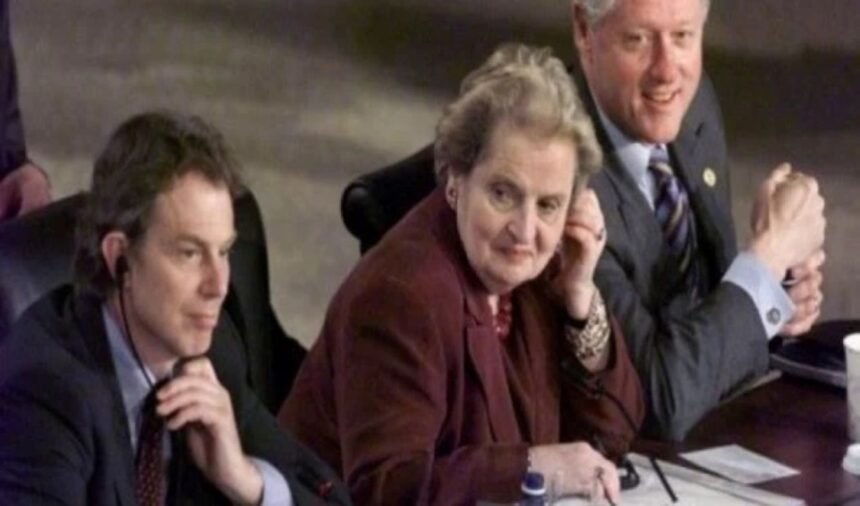
Twenty-seven years have passed since the historic declaration of the Contact Group issued in London, a turning point that decisively shaped the international response to the Kosovo crisis.
The Račak massacre ultimately eliminated the possibility of a peaceful settlement through direct Albanian–Serbian negotiations, an option that had been proposed for several years. Following this atrocity, diplomatic activity intensified across Washington, NATO, Brussels, and the Contact Group, with growing consensus that organizing an international conference should take priority over a policy of ultimatums.
The London Declaration and Rambouillet Conference
On January 29, 1999, the Contact Group met at Lancaster House in London, near St. James’s Palace, and issued its historic declaration calling for the Rambouillet Conference. The group also approved non-negotiable principles that would serve as the foundation for the Interim Agreement for Kosovo.
A day later, on January 30, the NATO Council reaffirmed its October decision, thereby establishing a clear diplomatic framework for the Rambouillet negotiations.
According to former Albanian Foreign Minister Paskal Milo, the spirit of the Contact Group’s declaration left no doubt about the determination to reach a solution and begin negotiations before spring, describing it as “almost an ultimatum.”
Reactions and Diplomatic Positions
In Belgrade, the declaration was received negatively. Albania, through its ambassador to France Luan Rama, requested observer status at the Rambouillet talks, a request that was rejected. French officials justified the decision by stating that no additional Balkan observers would be included and that Rambouillet would not be an international conference like the Dayton talks on Bosnia.
Growing Resolve for Military Intervention
By this stage, the Contact Group, supported by the UN Security Council and NATO, had moved firmly toward considering military intervention. The United States government, in particular, had begun exerting strong pressure for possible military action to halt repression in Kosovo.
The threat of force by the United States in relation to Kosovo dated back to 1992, when then-President George H. W. Bush warned Slobodan Milošević that the U.S. would be prepared to use military force in Kosovo and Serbia itself. This stance was later reiterated by the Clinton administration.
NATO and UN Security Council Actions
Former NATO Secretary General Javier Solana stated that the Alliance had reviewed military planning options to stop violence and create conditions for negotiations, including ground and air forces, with particular emphasis on a wide range of air-power options to enable rapid and effective action if necessary.
The UN Security Council adopted Resolutions 1160 (1998) and 1199 (1998) under Chapter VII of the UN Charter, requiring Belgrade to cease all military actions. Such resolutions are widely regarded as initial steps toward stronger measures, including military intervention.
Notably, Russia’s Foreign Minister Igor Ivanov voted in favor of Resolution 1199, signaling a temporary departure from Moscow’s traditionally firm support for Belgrade. Russian officials later justified the vote by stating that the resolution was intended to encourage direct dialogue between Belgrade and Kosovo.