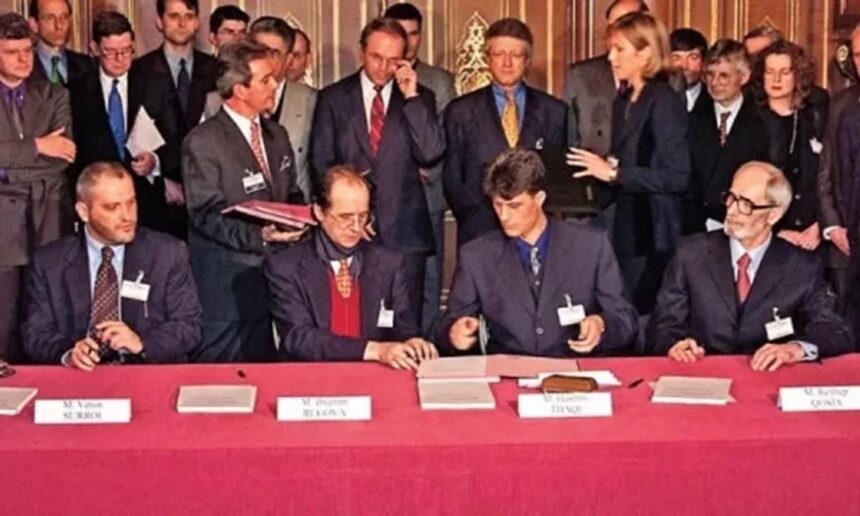
Twenty-seven years ago, on February 6, 1999, the Rambouillet Conference began its proceedings. This meeting, held near Paris, France, aimed to find a solution to the crisis in Kosovo.
The conference, which lasted until February 23, was initiated by the Contact Group, while mediation was led by Christopher Hill (United States), Boris Maiorsky (Russia), and Wolfgang Petritsch (European Union).
The Kosovo delegation accepted in principle the proposed agreement for resolving the Kosovo crisis, which had been put forward by the Contact Group. The Serbian delegation, although it also accepted the proposal in principle, insisted that NATO troops should not be allowed to pass through Serbia and that international forces in Kosovo should operate under the framework of the United Nations.
The second round of talks, which began on March 15 in Paris, also ended without success. On March 18, the Kosovo and Serbian delegations signed different agreements. The Kosovo delegation signed the agreement offered by the international mediators, while the Serbian delegation signed only the political draft agreement concerning self-governance in Kosovo.
The final attempt, on March 22, 1999, by the US Special Envoy Richard Holbrooke, was unsuccessful. He failed to persuade the then-president of the Federal Republic of Yugoslavia, Slobodan Milošević, to accept the agreement on Kosovo and the deployment of international troops.
On March 24, 1999, NATO launched air strikes against Serbian military and paramilitary forces. The bombing campaign ended on June 6, 1999, with the signing of the Kumanovo Agreement, which provided for the withdrawal of Yugoslav forces from Kosovo and the deployment of international peacekeeping troops.
Subsequently, the UN Security Council adopted Resolution 1244, establishing an international presence in Kosovo, including UNMIK as the civilian mission and KFOR as the military mission.
Finally, on February 17, 2008, Kosovo declared independence.