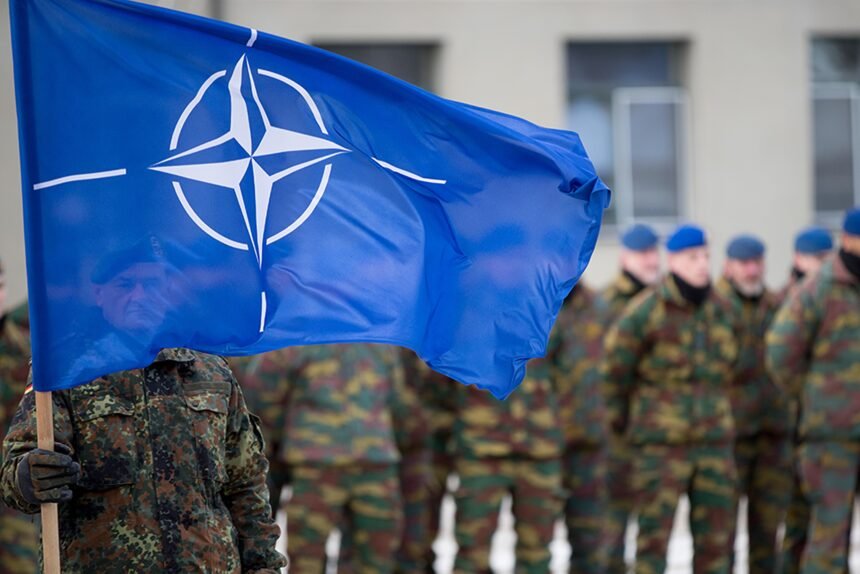
Founded 77 years ago at the start of the Cold War, NATO became the leading organization for collective defense, bringing together member states across Europe and North America.
Established on April 4, 1949, in Washington, D.C., NATO initially had 12 founding members: 10 European countries, the United States, and Canada.
The alliance was created to counter the threat of the Soviet Union and is based on the principle of mutual solidarity, as defined in Article 5: an armed attack against one member is considered an attack against all.
Over time, new members joined, including Greece and Turkey (1952), Germany (1955), and Spain (1982).
After the dissolution of the Soviet Union in 1991, NATO entered a new phase. In 1997, it signed the NATO-Russia Founding Act with Russia.
First military engagements
NATO carried out its first combat operation on February 28, 1994, shooting down four Serbian aircraft over a UN no-fly zone in Bosnia and Herzegovina.
On December 16, 1995, it launched its first major operation in Bosnia, deploying 60,000 troops as part of the Implementation Force.
On March 24, 1999, NATO began a 78-day air campaign in Kosovo to halt Serbian repression against ethnic Albanians. The campaign led to Serbian withdrawal and the deployment of the KFOR peacekeeping mission. Kosovo later declared independence in 2008.
Post-2000 developments
After the September 11 attacks, the United States invoked Article 5 for the first time. NATO then joined the fight against terrorism and, in 2003, took command of the International Security Assistance Force in Afghanistan, which lasted until 2014.
The alliance expanded further in 2004, welcoming countries such as Slovakia, Slovenia, Bulgaria, Romania, Lithuania, Estonia, and Latvia—a move that heightened tensions with Russia. Later, Albania and Croatia joined in 2009, followed by Montenegro in 2017.
In 2011, NATO led the UN-mandated intervention in Libya, known as Operation Unified Protector, which resulted in the fall of Muammar Gaddafi.
Modern challenges
NATO has also worked to combat piracy off the coast of Africa and, since 2016, has deployed surveillance ships in the Mediterranean to counter human trafficking. The alliance also supports its members in strengthening cyber defense capabilities.
Tensions with Russia intensified after the annexation of Crimea in 2014, leading NATO to suspend cooperation with Moscow. In 2016, the alliance deployed multinational battlegroups in Estonia, Latvia, Lithuania, and Poland—its most significant reinforcement of collective defense since the Cold War.
In 2018, NATO conducted its largest military exercises since the Cold War in Norway, just a few hundred kilometers from the Russian border.