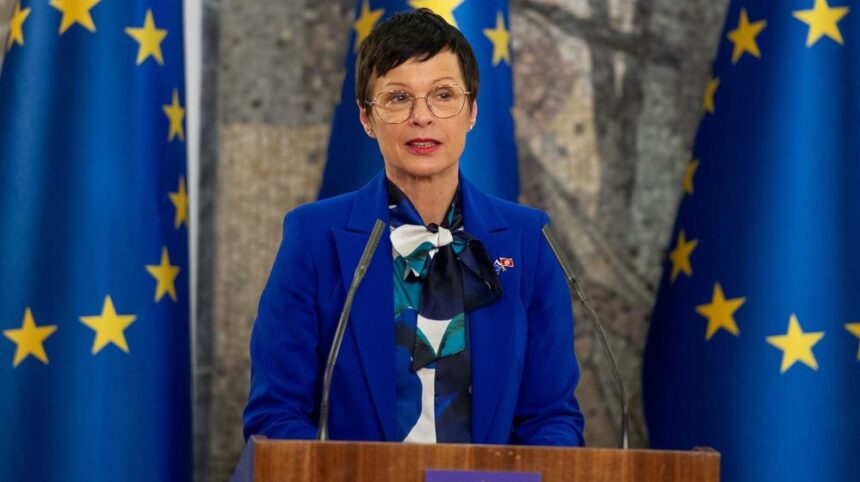
European Commission Enlargement Commissioner Marta Kos has expressed concern over recent judicial reforms in Serbia, describing them as a step backward that threatens the country’s EU accession process. In an interview with N1, Kos warned that the reforms, signed into law by President Aleksandar Vučić, undermine judicial independence and weaken the credibility of Serbia’s commitment to European standards.
“These recent changes clearly represent a regression,” Kos said. “They interfere with the independence of the judiciary and prosecution, which is at the very core of the EU accession process. This has affected our trust in Serbia.”
Kos declined to speculate on Vučić’s motivations, noting only that her team’s internal assessment “is not good”. She emphasized that the EU expects the Serbian government to suspend the implementation of these laws and to engage in a thorough, transparent review with consultation from the European and Venice Commissions.
A Pattern of Political Backsliding
The commissioner highlighted the broader political implications of the reforms. “It is not just about the laws themselves, but about why they were enacted despite clear warnings from experts and the European Commission. This sends the wrong signal about Serbia’s commitment to EU accession,” Kos said.
She stressed that Serbia’s backward steps stand in contrast to neighboring candidate countries, such as Albania and Montenegro, which are advancing more steadily. “The delay may seem small, but if these laws are not revised, it could cause serious setbacks in the accession process,” she warned.
Dialogue Over Sanctions
Despite criticism from some European lawmakers calling for targeted sanctions, Kos said she favors strict rules and monitoring rather than punitive measures. “I am against sanctions. We must resolve these issues through dialogue, not punishment,” she explained, highlighting the need for political will and genuine commitment from Serbian leaders.
The Broader Regional Context
Kos also commented on the fragile political climate in the Western Balkans, emphasizing the importance of EU engagement to maintain stability. She praised ongoing reforms in Montenegro and Albania while noting that Bosnia and Herzegovina still faces structural obstacles, including political fragmentation that hampers EU integration.
A Message to Serbia
The commissioner’s remarks underscore a growing frustration in Brussels with Vučić’s administration. While Kos remains optimistic that Serbia can return to a path compatible with EU standards, her statements implicitly criticize the regime for prioritizing political control over rule of law and democratic reforms.
“Reversals like these create risk,” she said. “They slow progress and raise doubts about whether the Serbian government is committed to delivering real reform for its citizens.”
Kos concluded with a reminder that EU enlargement is not merely technical compliance. Political will and adherence to democratic principles are equally crucial. “We want the Western Balkans to join the EU, but only if accession strengthens Europe, not weakens it,” she stated.