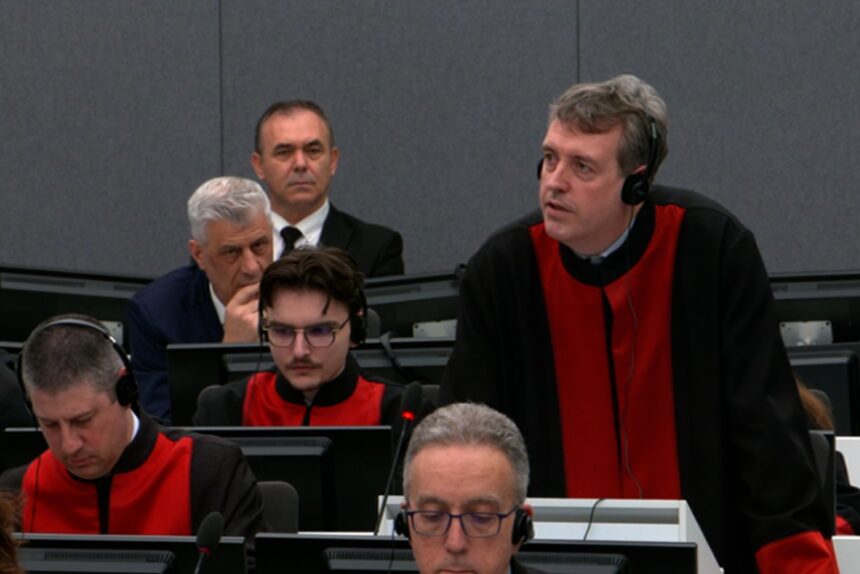
Rexhep Selimi’s defense counsel, Geoffrey Roberts, rejected all allegations raised against his client concerning the appointment of certain individuals during the war period.
He stated that, despite the absence of basic evidence, the Specialist Prosecutor’s Office (SPO) continues to advance claims that attempt to fill evidentiary gaps with speculation.
“In the Prosecution’s case file, it is alleged that Mr. Selimi was responsible for reviewing proposals for appointments, including for operational zones, which were later discussed by the General Staff. This assertion is based on two handwritten notes. Both refer to the creation of various commissions. Mr. Selimi’s name appears only in one undated note, listed as a member of the personnel council. The other document does not mention him, nor does it identify him as a member of the personnel council. None of the witnesses identified his absence from that list or sought to correct the document to include him,” Roberts said.
He added that the evidence concerning the Personnel Council, even if it existed and had been functional, is extremely limited — similar to arguments previously raised in the defense of Hashim Thaçi. Regarding the alleged meeting of 12 February 1999, where the prosecution claims a decision was made to replace Commander Drini as commander of the Pashtrik Zone, Roberts argued that this has very little to do with the Personnel Council.
“The speculation that it was the Personnel Council that provided the reasoning for the proposed replacement is not based on actual knowledge,” he added.
Selimi’s defense also denied claims that his client led any debate or discussion during the meeting, noting that the relevant witness was unable to explain why another individual present at the same meeting had given a different account to the prosecution.
The witness could not confirm Mr. Selimi’s participation or that of General Staff members, nor did he recall any public debate during the meeting.
“The defense addressed in detail the replacement of Commander Drini. In their file, the prosecution’s attempt to link this action to the promotion of Sylejman Selimi is also misplaced. The SPO has presented no evidence that Mr. Selimi was responsible in any way for that action,” Roberts stated.
He further noted that the prosecution claims that Mr. Selimi’s selection as KLA commander and the replacement of Azem Syla are unsupported by evidence showing that this was planned and implemented by Selimi.
“Like much of the prosecution’s case, this is simply rumor and insinuation rather than something grounded in evidence,” the lawyer said.
Roberts also addressed the SPO’s claim that Selimi was part of a limited group controlling appointments to ensure that the “right individuals” were in place to implement a common purpose.
“They would secure the proper appointments and promotions. This is a bombastic statement, referring to Mr. Selimi’s alleged appointments of Faton Mehmetaj, Kadri Kastrati, and another individual. There is no claim or evidence that these appointments served to implement any common plan,” Roberts argued.
He added that, according to the prosecution’s file, Ahmetaj’s appointment occurred in the context of efforts to resolve a situation involving Tahir Zemaj in August 1998, while Mehmetaj had previously served in the Dukagjin Zone, appointed by Ramush Haradinaj.
The defense questioned how the prosecution could argue that these appointments were part of a plan to install individuals loyal to Selimi.
“No witness or documentary evidence supports this claim, and the prosecution did not question the witness to confirm it,” Roberts said.
He also addressed two additional names that the prosecution claims were appointed by Selimi.
“The prosecution alleges that Mr. Selimi assigned Nexhmi Kastrati to a prison command role and that Nexhmi had previously overseen detentions and abuses in cooperation with Mr. Selimi. However, the only appointment with which Mr. Selimi is linked concerns Krasniqi’s role as commander of the military police of the Pashtrik Zone in 1999, which has been extensively addressed and challenged by the defense,” Roberts stated.
He added that the final alleged appointment, when Selimi served as Minister of Public Order, was based on witness 4738 and the prosecution’s file, and ultimately was not admitted into evidence.
“Despite the lack of an evidentiary foundation, the SPO nevertheless continues to rely on this claim in order to bridge evidentiary gaps with speculation,” Selimi’s defense counsel concluded.
Selimi’s defense team will continue presenting its arguments during the first part of Friday’s session, when the defense of Jakup Krasniqi is also expected to address the court.