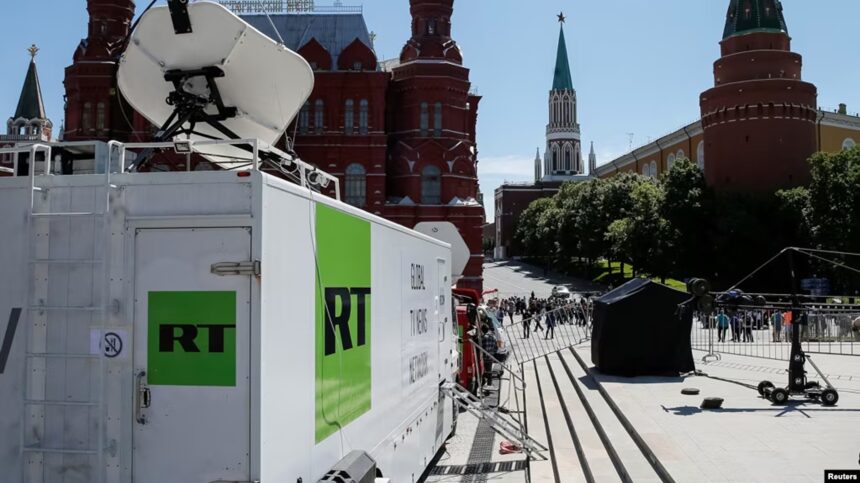
Seven cable operators in Bosnia and Herzegovina (BiH) continue to distribute programming from six Russian state television channels that have been under European Union sanctions since March 2022.
The sanctioned outlets including RT (Russia Today), Russia 24, and Sputnik — were banned by the EU for spreading disinformation, justifying Russia’s aggression against Ukraine, and conducting what Brussels describes as hybrid warfare. Despite the EU-wide prohibition on distribution through cable, satellite, IPTV platforms, and online applications, the channels remain accessible in Republika Srpska (RS) and in certain parts of the Federation of BiH.
Some of the operators carrying the sanctioned channels are owned by Telekom Srbija through its subsidiary m:tel, according to business registry data.
EU: Full Implementation of Sanctions Expected
The European Commission told Radio Free Europe (RFE/RL) that it expects Bosnia and Herzegovina to fully implement EU restrictive measures, including those targeting Russia and Belarus.
“We encourage and expect that BiH will ensure full implementation of EU restrictive measures,” the Commission stated, emphasizing that foreign information manipulation and interference pose a growing threat to democratic societies.
Brussels has repeatedly characterized Russian state media as instruments of information warfare. “The Kremlin regime has transformed state media into tools of information manipulation,” the Commission noted, explaining that sanctions were introduced as a security measure rather than as standard media regulation.
Although EU member states have not blocked access to the websites of sanctioned Russian outlets, distribution via cable and satellite networks within the EU has been prohibited since the start of Russia’s full-scale invasion of Ukraine in February 2022. Major social media platforms, including YouTube, Meta, and TikTok, have also restricted or blocked Russian state media content.
Hybrid Influence in BiH
Security analysts warn that the continued broadcasting of Russian channels in BiH fits into a broader pattern of geopolitical influence.
Ahmed Kico, a retired intelligence officer and co-author of Bosnia and Herzegovina and the Western Balkans – Aspects of Geopolitics and Hybrid War, described the situation as part of a “hybrid war against BiH.”
“Russia’s interest in Bosnia and Herzegovina is to halt its further integration into NATO and delay its EU integration,” Kico said, arguing that Russian influence operates both directly and through regional media networks.
Bosnia and Herzegovina has held EU candidate status since 2022.
Distribution in the Federation and Republika Srpska
Most cable operators in the Federation of BiH reportedly ceased distribution of Russian state channels in 2022, aligning with EU measures without a formal state-level ban.
However, according to program lists submitted to the Communications Regulatory Agency of BiH (RAK), Russian channels remain available via several operators. Russia Today and Russia 24 are accessible through the ELTA-MT network in the Tuzla area and Logosoft in the Sarajevo area. Logosoft is owned by Telekomunikacije Republike Srpske (m:tel), majority-owned by Telekom Srbija.
In Republika Srpska, five cable operators continue to carry sanctioned channels, including two owned by m:tel and three privately held companies.
Operators contacted by RFE/RL did not respond to requests for comment.
Regulator’s Limited Authority
Under BiH law, cable operators must submit copyright agreements to RAK in order to distribute foreign television programming. However, while RAK can impose fines for violations such as hate speech or intentional misinformation, it does not have the authority to ban channels outright.
In response to inquiries, RAK stated that it had “no specific comments” regarding the distribution of EU-sanctioned Russian media.
RAK is currently headed by Draško Milinović, former director general of Radio Television of Republika Srpska and a former advisor to Milorad Dodik, who maintains close ties with Moscow. Dodik has met Russian President Vladimir Putin multiple times since the outbreak of the war in Ukraine.
Political Divisions Over Sanctions
The European Union has repeatedly stressed that Bosnia and Herzegovina must align with EU foreign policy measures, including sanctions against Russia. The European Parliament has expressed concern over Russian propaganda in Republika Srpska and called for stronger support to BiH in countering disinformation campaigns.
Foreign Minister Elmedin Konaković has publicly supported sanctions against Russia, but implementation at the state level has reportedly been blocked by ministers from Republika Srpska.
Conversely, Staša Košarac, Minister of Foreign Trade and a member of SNSD, has argued that “BiH sanctions against Russia do not exist” as long as officials aligned with RS policies hold positions in state institutions.
Ongoing EU Concerns
In its progress reports, the European Commission has warned that Bosnia and Herzegovina lacks a comprehensive framework to counter hybrid threats and remains vulnerable to foreign political influence and cyberattacks.
The continued availability of sanctioned Russian media outlets in parts of the country underscores the political and regulatory challenges facing BiH as it seeks closer integration with the European Union.