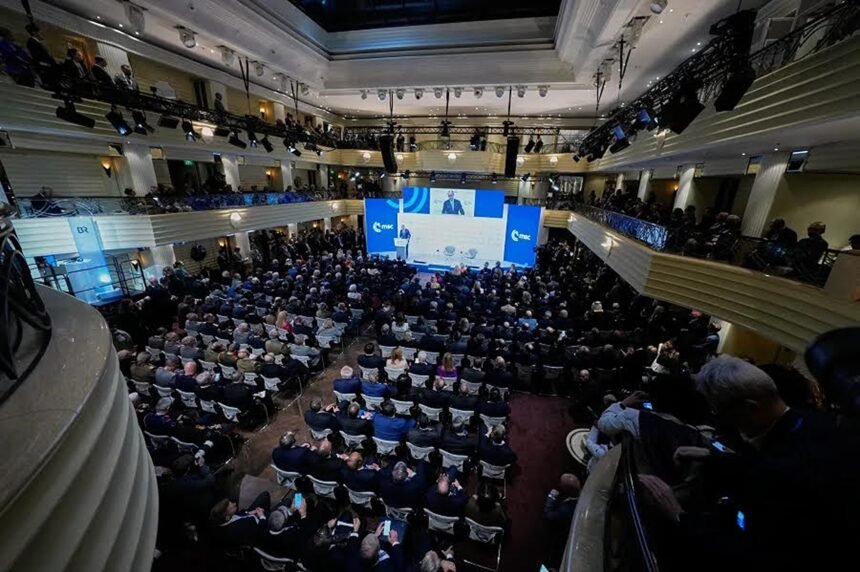
The Munich Security Conference (MSC 2026) was a key moment when Europe publicly acknowledged that the international order has changed and that it can no longer wait for Washington. While Berlin, Warsaw, and Paris are drafting a new security map for the continent, Serbia appeared more as an observer than as an active player.
Here are five points that define Serbia’s position at MSC 2026: Europe moves forward, Serbia stays on the sidelines.
1. Europe’s Strategic Autonomy Accelerates
The conference clearly showed that Europe has entered a new phase. Germany, under the leadership of Friedrich Merz, launched the deepest transformation of security and industry since World War II.
- Germany’s record defense budget of €108.2 billion and the trillion-dollar infrastructure and defense package are part of a broader European shift, totaling €6.5 trillion in investment over the next decade.
- This is not just a response to the war in Ukraine or the unpredictability of the United States; it is a strategic decision to make Europe a more politically, militarily, and industrially independent actor.
2. Serbia’s Marginal Role
Although Aleksandar Vučić was present at MSC 2026, Serbia did not play a significant role:
- The country was absent from key panels and strategic discussions that will shape the continent over the next decade.
- Decisions regarding the new European defense architecture and industrial strategy proceeded without Serbian involvement.
3. Vučić’s Main Bilateral Meeting
Vučić’s most notable bilateral engagement was with the Chinese Foreign Minister, focusing on:
- Reaffirming the “steel friendship” and infrastructure projects rooted in an earlier geopolitical era.
- Demonstrating that Serbia’s attention remains oriented toward older alliances rather than integrating into Europe’s evolving security framework.
4. Europe Moves Forward, Serbia Stays on the Sidelines
Europe is actively defining its future, while Serbia remains on the periphery:
- Key decisions regarding defense, technology, and industrial capacity move ahead without Serbian participation.
- Serbia risks becoming irrelevant in shaping the European security landscape despite its geographic proximity.
5. Strategic Implications
- Europe’s transformation indicates a more independent and capable continent, reducing reliance on the United States.
- Serbia’s observer role suggests limited influence in Europe’s strategic decisions, potentially constraining its geopolitical leverage.
In conclusion, MSC 2026 highlighted Europe’s push for autonomy and Serbia’s marginal position, underscoring a growing gap between continental strategy and Belgrade’s international role.