Serbia’s path toward European Union membership is facing serious setbacks, according to European Parliament rapporteur for Serbia, Tonino Picula, who sharply criticized Belgrade’s political leadership for refusing dialogue with key European institutions.
In a political commentary published Tuesday, Picula argued that Serbia’s government is selectively engaging with European officials while avoiding critics, warning that such behavior undermines the country’s accession ambitions with the European Union.
“EU Is Not a Swedish Buffet”
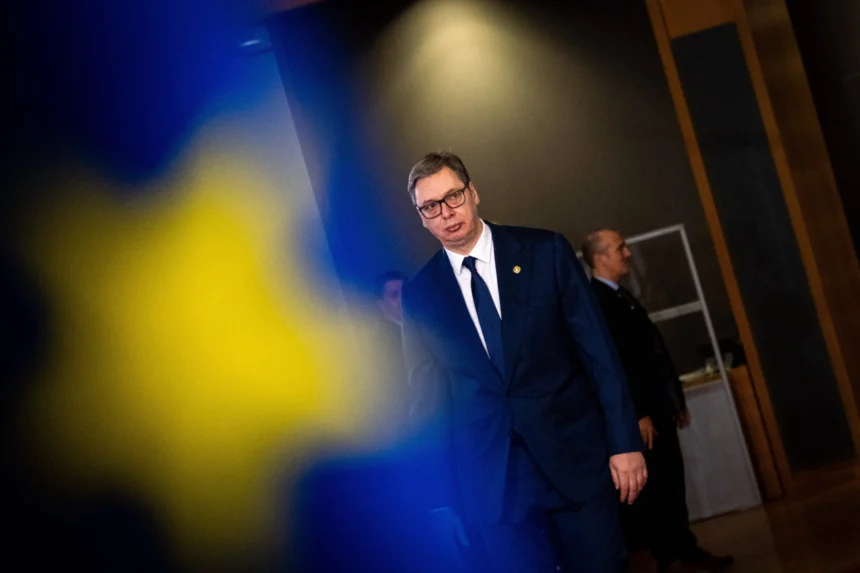
Picula stated that Serbian President Aleksandar Vučić treats relations with the EU selectively, engaging only with favorable interlocutors while dismissing criticism from European representatives.
He also noted that Vučić and Serbian Parliament Speaker Ana Brnabić refused to meet with a European Parliament delegation sent to assess Serbia’s political climate, democratic standards, and foreign policy orientation.
“Serbia’s leadership does not want the European Parliament delegation, the standing rapporteur, or even their political partners within the European People’s Party,” Picula said, referring to the European People’s Party (EPP).
Concerns Over Democracy and Political Repression
The European Parliament delegation visited Serbia following a resolution adopted in October 2025 addressing political polarization and increased repression in the country. According to Picula, the mission sought to evaluate:
- The state of democracy and rule of law
- Allegations of police violence against protesters
- Reported repression against students, academics, and public sector workers
- Serbia’s alignment with EU accession requirements
Picula said meetings with civil society organizations, media representatives, and academic institutions revealed increasing financial, administrative, and physical pressure against groups supporting student protests, as well as growing political control over media and state institutions.
Government Officials Reject Criticism
Picula noted that while Serbian Foreign Minister Marko Đurić and several parliamentary representatives met with the delegation, other members of the ruling coalition — including figures linked to the Serbian Progressive Party (SNS) — focused on historical disputes and criticism of individual EU lawmakers rather than discussing reforms.
Opposition representatives, meanwhile, reportedly urged the European Parliament to consider sanctions against senior government officials and called for stronger international election monitoring.
Legal and Institutional Setbacks
Picula also expressed concern over Serbia’s adoption of amendments to judicial laws without consultations with the Venice Commission or the European Commission. He warned that the changes could weaken judicial independence and strengthen political control over state institutions.
Additionally, European officials raised alarms over government agreements bypassing EU public procurement rules.
Accession Talks Falling Behind Regional Peers
According to Picula, Serbia has failed to open a single new negotiation chapter in four years, indicating clear stagnation in the accession process. He added that while EU enlargement has regained political importance, Serbia is falling behind other candidate countries, including Montenegro and Albania, which have advanced more rapidly in negotiations.
He stressed that EU accession is primarily a political process requiring genuine democratic reforms rather than technical adjustments.
Deep Social Divisions and Historical Challenges
Picula described Serbian society as deeply polarized, with some analysts characterizing the country as a hybrid system with elements of state capture. He also pointed to Serbia’s unresolved historical legacy, noting that post-2000 reforms have struggled to overcome structural issues dating back to the era of former Serbian leader Slobodan Milošević.
Key Question Remains Serbia’s Political Will
Picula concluded that the central issue is not whether the EU is willing to accept Serbia, but whether Serbia’s leadership is prepared to adopt the democratic standards required for membership.
He warned that without political consensus and meaningful reforms, Serbia risks further delaying its European integration and losing strategic momentum within the expanding group of EU candidate countries.