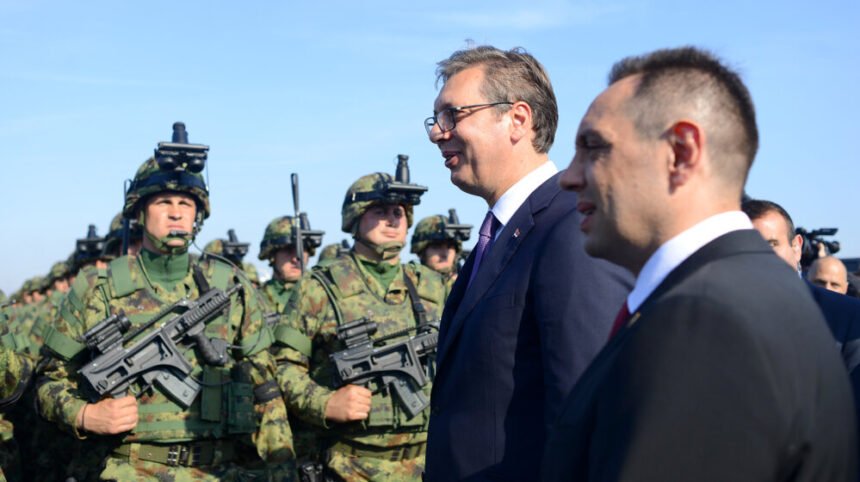
In recent weeks, Serbian President Aleksandar Vučić has repeatedly warned that a purported military alliance between Albania, Kosovo, and Croatia poses an imminent threat to Serbia. Vučić claims this alliance was created to attack the country and has suggested that Serbia must rapidly bolster its defense capabilities in response.
Speaking at the Munich Security Conference on February 13, Vučić described the alliance as a potential “coordinated action on an eastern front,” warning that Serbia could face aggression unless it strengthens its military. He further announced increased investments in domestic defense production, including redirecting a significant portion of Serbia’s military industry to supply the army directly.
However, many political analysts and opposition figures sharply criticize Vučić’s narrative as politically motivated fear-mongering.
Opposition Leaders Reject the Threat Claims
Radomir Lazović, co-chair of the Green-Left Front, argued that Vučić uses the specter of external enemies to radicalize his base, maintain control, and portray himself as the nation’s protector. “The only entity benefiting from this perceived conflict is Vučić himself,” Lazović told Danas. “He wants citizens to fear the outside world so they remain loyal to him, while opposition voices are deliberately divided and weakened.”
Srđan Milivojević, president of the Democratic Party, noted that Serbia’s alleged external threats are far less dangerous than Vučić’s own policies. “Much of Serbia’s strategic resources and national achievements have been compromised under his leadership,” Milivojević said. “Albania, Croatia, and Kosovo have no incentive to attack Serbia. Their regional cooperation is about NATO integration, not aggression.”
Janko Veselinović, of the Freedom and Justice Party, criticized Vučić for prioritizing weapons over citizens’ welfare, highlighting that vast sums are being spent on arms instead of improving infrastructure, healthcare, or education. “Investing in militarization never brought prosperity to the Balkans,” Veselinović said.
Pavle Grbović, president of the Movement of Free Citizens, echoed the sentiment, warning that Vučić’s so-called neutrality has isolated Serbia from regional security processes. He emphasized that the alleged alliance is focused on NATO integration and collective security, not offensive operations against Serbia.
Political Context: Fear as a Tool
Observers note that Vučić’s claims serve multiple political purposes:
- Justifying increased military spending while consolidating political control.
- Distracting from domestic governance failures, including economic stagnation and public sector mismanagement.
- Polarizing Serbian society by framing neighboring states as threats.
Analysts stress that this pattern of fear-mongering is consistent with Vučić’s broader political strategy, which often involves exaggerating external threats to maintain power. Opposition figures argue that instead of escalating tensions, Serbia should focus on regional cooperation, economic development, and democratic reforms.
Conclusion
While Vučić presents the alliance of Albania, Kosovo, and Croatia as a national security threat, experts and opposition leaders emphasize that the reality is far less dire. The alliance is primarily about regional integration and NATO participation, not military aggression. Critics warn that Vučić’s rhetoric risks alienating Serbia from the EU and its neighbors, while funneling resources into defense instead of improving citizens’ livelihoods.
In short, the greatest threat to Serbia may not come from outside its borders, but from the policies and strategies of its current leadership.