NATO peacekeepers in Kosovo could face operational and strategic challenges if the United States were to significantly reduce its military presence, warns retired U.S. Colonel Ray Wojcik, former head of the Office of Defense Cooperation at the U.S. Embassy in Pristina.
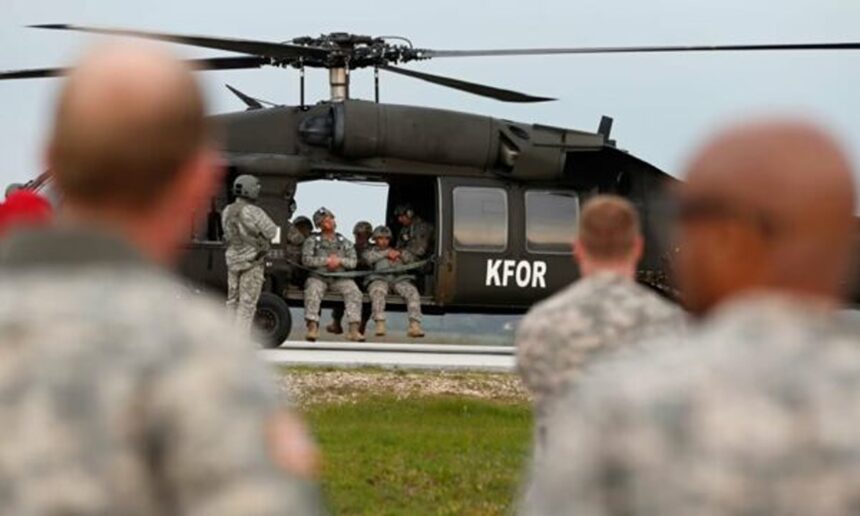
His comments follow reports by Politico suggesting that Washington is urging the alliance to scale back certain overseas commitments, including the Kosovo Force (KFOR) mission. Currently, around 590 U.S. troops serve within KFOR.
Gradual Transition — Not Abrupt Change
Wojcik stressed that while the United States is reviewing its global force posture with greater strategic focus on the Pacific and the Western Hemisphere any sudden withdrawal from Kosovo would be a mistake.
He emphasized that NATO’s long-standing plan has always envisioned a phased reduction of forces, but only once security conditions allow. Abrupt changes, he warned, could create uncertainty and open space for destabilizing actors to test the situation.
He noted that Kosovo has made substantial democratic and institutional progress since independence, particularly in strengthening the Kosovo Police and the Kosovo Security Force. These improvements may allow NATO to gradually transition from a frontline stabilization role to a more supervisory deterrence posture — but only under stable conditions.
Impact on Crisis Response
According to Wojcik, a major reduction of U.S. forces would most directly affect crisis prevention and rapid response capabilities rather than day-to-day security.
If reductions were to include key assets such as intelligence and surveillance, aviation support, medical evacuation, transport, or command personnel, KFOR’s ability to quickly detect and respond to sudden crises especially in sensitive areas could be weakened during a transitional period.
European NATO allies, he said, would need to step in to fill any capability gaps to preserve operational effectiveness and deterrence credibility.
Risks of External Influence
Wojcik also warned that a diminished U.S. presence could create opportunities for Russia and China to expand their political, economic, and informational influence in the Western Balkans.
He pointed to Russia’s political backing of Serbia and China’s growing infrastructure footprint across Europe as factors requiring a coordinated global deterrence strategy. He argued that preventing instability in Europe is directly linked to broader U.S. efforts to counter strategic competition globally.
Deterrence Beyond Numbers
Wojcik underlined that the U.S. military presence in Kosovo has a deterrent value far greater than its troop numbers suggest. It signals direct American strategic commitment and reinforces NATO unity.
Any serious incident involving U.S. forces, he noted, would trigger swift diplomatic, economic, and potentially military responses from Washington significantly increasing the cost of destabilizing actions.
NATO Membership: A Long-Term Anchor
When asked about Kosovo’s potential NATO membership, Wojcik described it as strategically vital but unlikely in the near term due to political recognition issues and the need for consensus among all alliance members.
However, he emphasized that deeper cooperation including participation in NATO exercises and continued bilateral initiatives like the Iowa–Kosovo State Partnership Program strengthens Kosovo’s long-term integration prospects and contributes to regional stability.