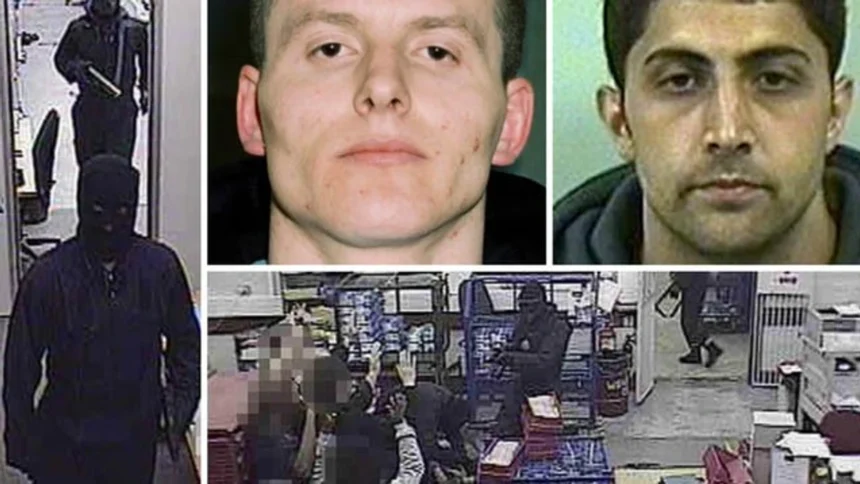
Twenty years after the largest cash robbery in British history, the attack on a Securitas depot continues to capture public imagination and remains an open case for the Kent police chief, as millions of pounds are still missing and at least one gang member has never been identified.
The robbers targeted the depot, a warehouse with a flat roof in an industrial area of Tonbridge, near the railway and car services, on February 21, 2006.
To secure access, the depot manager Colin Dixon, along with his wife and child, were kidnapped. Fourteen employees were held at gunpoint in cages while the gang loaded nearly £53 million in cash onto a truck. Millions more were left behind because the haul exceeded the truck’s capacity. A true-crime author noted that the robbers didn’t know the total amount of money in the building, as “there was so much cash.”
The Convictions
Five men were convicted at the Old Bailey trial in 2008: Stuart Royle, Lea Rusha, Jetmir Bucpapa, Roger Coutts, and Emir Hysenaj received prison sentences. Lee Murray was imprisoned in Morocco, and Paul Allen in the UK for his role in planning the heist.
Of the £32 million that was never recovered, Kent police chief Tim Smith still hopes some may be traced, though he notes that the old paper notes may have deteriorated over the decades.
“This happened before plastic banknotes were introduced; paper degrades. After 20 years buried… a significant portion may be destroyed,” Smith said.
Terror and Precision
Smith, the lead investigator on the night of the robbery, recalled that initially he only knew employees had been kidnapped to gain access to a cash depot he had never heard of before.
“The family was terrorized under gunpoint. For me, it was a kidnapping. The heist was only possible through the abduction of Mr. Dixon, his wife, and child—they went through hell,” he said.
Two decades later, Smith is convinced at least one suspect remains at large, and some of the missing cash might still be recoverable. Serial numbers exist for notes that never entered circulation.
“We would certainly be interested in any amount of cash someone might find,” he added.
How the Heist Happened
The robbery began when Dixon was stopped in his car by men dressed as police officers. Two other gang members, also in police disguises, went to Dixon’s home and told his wife and child he had been in an accident. The family was taken to a farm in Kent, where Dixon was bound and threatened with death unless he cooperated.
Once at the depot, one robber gained entry under Dixon’s supervision. Employees were tied up while cash was loaded into a 7.5-ton Renault truck before the gang fled.
Afterwards, over £9 million was found in a container in Welling, southeast of London, and £8 million in a warehouse in Southborough, with smaller amounts recovered elsewhere. Still, £32 million remains missing.
Nick Kochan, a journalist covering the case, described the robbery as “extraordinarily daring,” noting that while £53 million was stolen, a total of £154 million was left behind, making the potential haul close to £200 million.
Where the Money Went
Some of the money was spent on luxury lifestyles by the convicted, while other portions were invested in organized crime, including drugs and counterfeiting. Modern anti-money laundering systems would have flagged large deposits or transfers abroad, but twenty years ago such safeguards were not in place.
True-crime author Howard Sounes described the gang as “thugs and unsophisticated,” noting that they did not fully realize how much cash was in the building.
“They couldn’t steal more because the truck couldn’t carry it. When it came time to count, they didn’t even have the means—it was that much money,” he said.
Some money was moved abroad and converted to euros; other amounts were hidden in warehouses, sports bags, cabinets, and even a car cassette, with one member giving cash to his mother. During the trial, one man reportedly disappeared to the Caribbean, and Sounes suggested he may still be living off the loot.
Outstanding Orders and Police Appeals
Confiscation orders were issued for several of the convicts, but much of the cash remains unrecovered.
“Full orders, plus interest, remain payable, and we would not hesitate to bring these criminals back to court if additional assets are found,” a prosecutor said.
For instance, Hysenaj was ordered to pay £250,000 but failed, adding two more years to his sentence; Royle was ordered to pay £2 million but paid only £50,000, receiving an additional six years; Allen was ordered to pay £1.23 million, paid only £420.
Twenty years after the robbery, Kent police chief Tim Smith has renewed calls for information:
“Ultimately, if someone still needs to face justice, I’d like to see it happen for the sake of the victims. There are people out there who know something we don’t. One key piece of information could lead to other suspects.”
He stressed that, given the scale of the missing cash and the seriousness of the abduction and heist, police will follow up on any information.