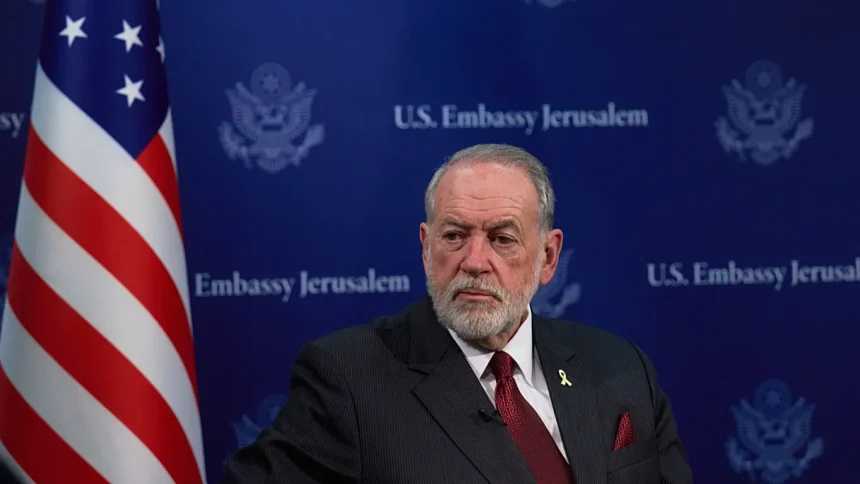
Middle East tensions escalate after US Ambassador to Israel Mike Huckabee suggested that Israel could exercise control over Arab territories, drawing strong condemnation from 14 Arab and Islamic countries and key regional organisations.
The coalition, which includes Qatar, Egypt, Jordan, UAE, Indonesia, Pakistan, Turkey, Saudi Arabia, Kuwait, Oman, Bahrain, Lebanon, Syria, and Palestine, along with the Gulf Cooperation Council (GCC), the Arab League, and the Organisation of Islamic Cooperation (OIC), released a joint statement denouncing Huckabee’s comments.
The statement described the remarks as “reckless”, saying they inflame tensions, threaten regional security, and violate international law and the UN Charter. The countries emphasized that Israel has no sovereignty over Palestinian or other Arab territories and called for an end to annexation plans and settlement expansion, reaffirming support for Palestinian self-determination and the establishment of an independent state along the 1967 borders.
Huckabee’s comments came during an interview where he suggested it would be acceptable for Israel to take control of lands claimed by Arab states, including the West Bank. Regional leaders warned that such statements undermine the two-state solution and could exacerbate violence in an already volatile region. Several states urged the US to clarify its official position and reaffirm its commitment to international law.
In parallel, diplomatic efforts continue: Qatar’s Prime Minister and Foreign Minister Sheikh Mohammed bin Abdulrahman bin Jassim Al‑Thani spoke by phone with Iran’s Foreign Minister Abbas Araghchi, highlighting ongoing engagement aimed at de-escalating tensions and supporting US-Iran negotiations.
The incident underscores the fragile state of Middle East peace efforts amid disputes over Israeli policies in the West Bank and Gaza, where remarks legitimising control over Arab lands risk inflaming violence and complicating future negotiations.