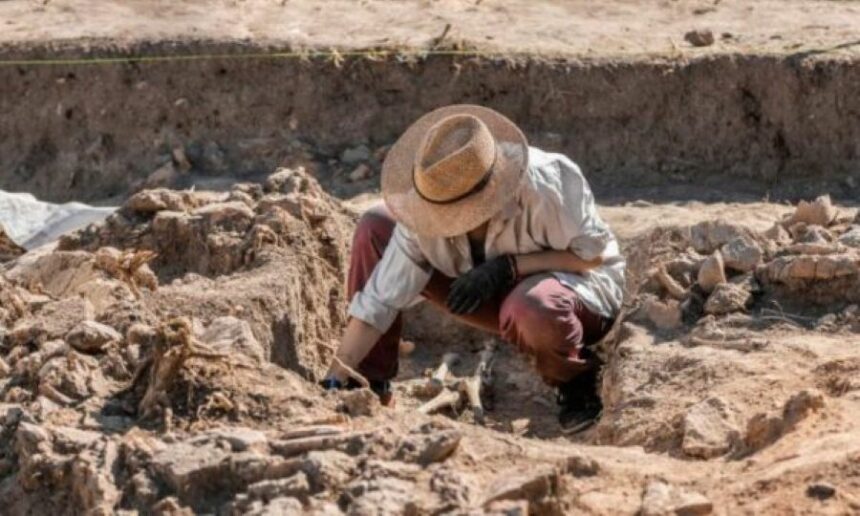
Archaeologists conducting excavations in the commune of Euxet-le-Valley have uncovered evidence that humans inhabited the area as far back as 7,000 years ago, according to Le Figaro.
The National Institute for Preventive Archaeological Research (INRAP) initiated the dig due to the expansion of a limestone quarry, requested by the state and the managing company. Excavations revealed two sites stacked atop one another—one from the Neolithic period and another from the Bronze Age, just ten meters apart.
- The Neolithic site dates to around 4900 BCE (6,000–2,300 BCE), believed to have housed mud-and-wood dwellings with thatched roofs, accommodating approximately a dozen people.
- The Bronze Age burial site, located only ten meters away, dates to around 1900 BCE (2,300–800 BCE).
According to Emmanuel Ghesquière, head of the archaeological team, no human remains were preserved due to soil acidity, but the site contained 31 finely crafted stone arrowheads and two bronze combs, measuring 20 and 30 centimeters in length. He described the arrowheads as decorative objects, akin to medals of honor of the time, showcasing extraordinary craftsmanship.
“These artifacts indicate that the area was inhabited during multiple periods, though not necessarily continuously,” Ghesquière added, emphasizing the symbolic and cultural significance of the Bronze Age burial.