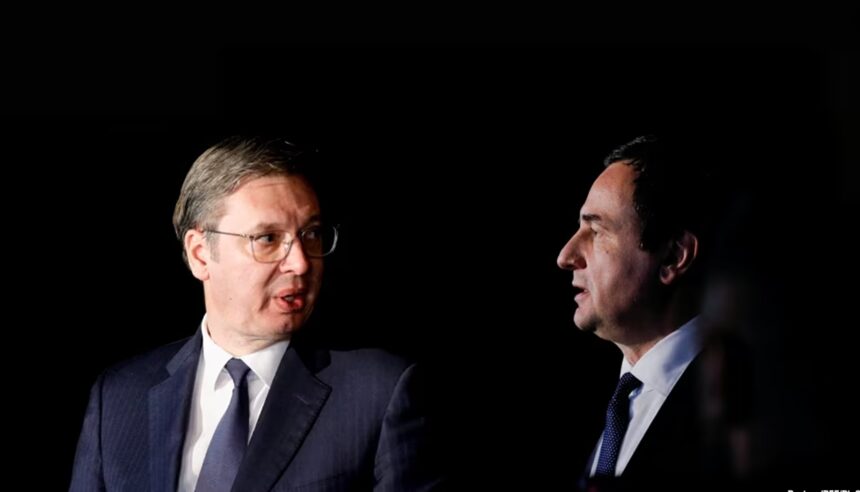
Serbian President Aleksandar Vučić has strongly criticized Kosovo Prime Minister Albin Kurti following Kurti’s call for the establishment of a special international court to investigate crimes known as the “Sarajevo Safari,” allegedly committed during the siege of Sarajevo in the early 1990s.
Kurti raised the issue during the second international scientific conference organized by the Kosovo Institute for War Crimes. He emphasized that there is serious information suggesting that individuals paid money to shoot Bosnian civilians with sniper rifles — a practice often described as “sniper tourism,” considered a grave war crime.
In his response, Vučić avoided directly addressing the call for an international investigation. Instead, he shifted the focus toward accusations against Pristina, linking the matter to other controversial topics, including the so-called “Yellow House” and territorial disputes.
“You can organize 1,000 courts, it’s worthless… Pristina’s nervousness is because of the Yellow House and the problems they have. We are only talking about the Yellow House, but the very fact that someone is taking 14% of territory is contrary to all provisions of international public law… They opened Pandora’s box themselves,” Vučić stated, adding that Serbia has always respected law and principles, unlike its counterparts.
Kurti reiterated that the so-called “Yellow House” in Albania — alleged to have been used for organ trafficking by members of the Kosovo Liberation Army — never existed as described, calling it part of what he labeled a Serbian hybrid narrative against the KLA and Albania. He noted that the claims were initially promoted in April 2008 by Russian MP Konstantin Kosachev, shortly after Kosovo’s declaration of independence.
Observers argue that Vučić’s reaction represents an attempt to relativize wartime crimes and redirect the debate away from historical accountability toward present-day political disputes.
Kurti’s call for a special tribunal has been supported by several academics and civil society representatives, who maintain that an independent investigation into war crimes in Bosnia and Herzegovina remains essential for transitional justice and regional reconciliation.
Allegations Linking Vučić to Civilian Killings in Sarajevo
Croatian investigative journalist Domagoj Margetić has published numerous articles and documents allegedly connecting Vučić to the “Sarajevo Safari.”
Margetić secured an interview with Aleksandar Ličanin, who claims to have been a direct witness to the killing of civilians during the war in Bosnia and Herzegovina.
Ličanin stated that he observed Serbian forces’ actions firsthand, mentioning names such as Slavoj Aleksić, Vojislav Šešelj, and Aleksandar Vučić. According to him, crimes included the killing of innocent civilians — children, women, and the elderly.
He further alleged that foreign “sniper tourists” were organized and brought to positions near Sarajevo’s Jewish cemetery, from where they allegedly fired on the city.
When asked about claims that Vučić personally used a sniper rifle from that location, Ličanin responded affirmatively, asserting that photographs exist showing individuals carrying sniper rifles. He also suggested that fear prevents many people from speaking publicly about wartime events.
Margetić has also published a 1992 document titled “Chetnik Unit of Novo Sarajevo,” which allegedly outlines internal orders regarding sniper positions on Lenin Street in Novo Sarajevo. The document reportedly states that only three individuals had authorized access to specific sniper positions: Veljko Papić, Aleksandar Vučić, and Zlatko Novković.
According to the journalist, the document serves as direct evidence linking Vučić to Chetnik structures in Novo Sarajevo during the Bosnian war, a period when he was politically affiliated with the Serbian Radical Party (SRS).
The allegations remain highly sensitive and politically contentious, with no judicial ruling confirming the claims.