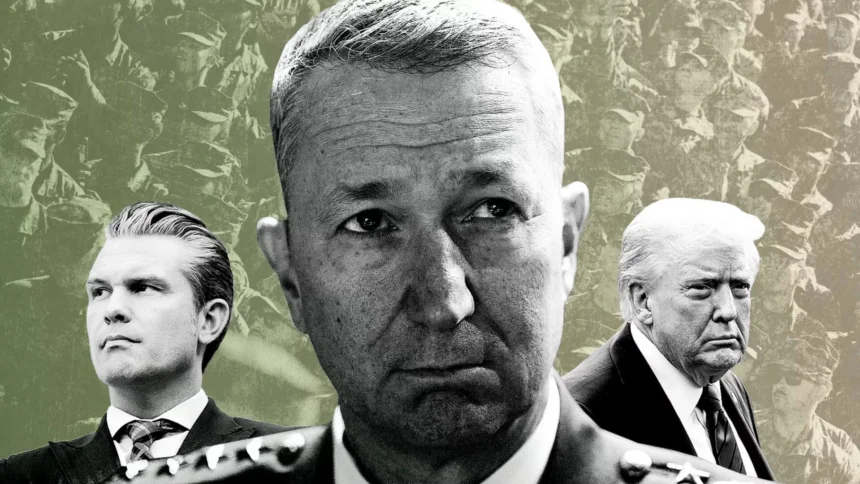
General Dan Caine, Chairman of the U.S. Joint Chiefs of Staff, has been overseeing an extremely secretive military planning process for a potential U.S. operation against Iran, prioritizing operational security and disciplined information control over public visibility.
Unlike standard high-level Pentagon forums, Caine has preferred smaller, tightly controlled sessions, reflecting both operational sensitivity and political pressure, ensuring that key military leaders are fully briefed while minimizing information leaks.
During these internal reviews, Caine repeatedly highlighted risks of escalation, Iran’s defensive capabilities, and potential U.S. casualties, presenting assessments far more cautious than President Donald Trump’s public statements, which characterized military action as swift and decisive.
The planning process has produced a wide range of options requested by the White House, from targeted strikes on nuclear and missile infrastructure to more ambitious scenarios involving regime change. Caine reportedly refused to offer definitive predictions on the outcomes of such aggressive options, citing intelligence uncertainties and post-conflict stabilization challenges.
Observers note that Caine’s restrained approach avoids public clashes, contrasting with tensions previously seen between Trump and former Joint Chiefs Chairman Mark Milley. His focus has been on process integrity, offering detailed operational choices, assessing secondary and tertiary effects, and maintaining his legally mandated advisory role.
Within the administration, Caine is considered a trusted operational voice, working closely with Vice President JD Vance, Secretary of State Marco Rubio, and White House Chief of Staff Susie Wiles, while maintaining direct access to Trump on sensitive matters. His cautious stance aims to preserve institutional trust and military morale amid rapidly changing leadership and political pressures.
Operationally, Caine’s tenure coincides with the largest U.S. force buildup in the Middle East since the Iraq invasion, alongside ongoing campaigns against Iran-backed groups. He has played a central role in high-level briefings on U.S. strikes against Iranian targets, emphasizing technical execution over political signaling.
Inside the Pentagon, opinions on Caine remain mixed: some praise him as a disciplined professional navigating a highly politicized environment, while others argue that his low-profile approach may limit influence during critical decision points. Ultimately, his leadership reflects careful balancing of credibility, advisory duties, and strategic pressures surrounding a potential conflict with Iran.