PRISTINA — February 27, 2026 — A recent analysis of incidents targeting religious sites in Kosovo reveals a sharp contrast between official records and claims circulated by Serbian officials, shedding light on how numbers are sometimes politicized to shape perception.
In 2023, a door forced open or a missing donation box at an Orthodox church could prompt Belgrade to describe a “wave of intimidation” against the Serbian population. But Kosovo Police records tell a different story.
Steady Decline in Incidents
Official data shows that overall incidents against religious heritage sites have been steadily decreasing over the past three years:
- 2023: 79 cases
- 2024: 53 cases
- 2025 (Jan–Oct): 28 cases
This represents a 64.5% decline from 2023 to 2025, with no statistical evidence of a “wave” of attacks.
Orthodox vs Other Religious Sites
Between 2023 and 2025, the breakdown by confession is revealing:
- Orthodox heritage: 47 cases
- Islamic heritage: 102 cases
- Catholic heritage: 11 cases
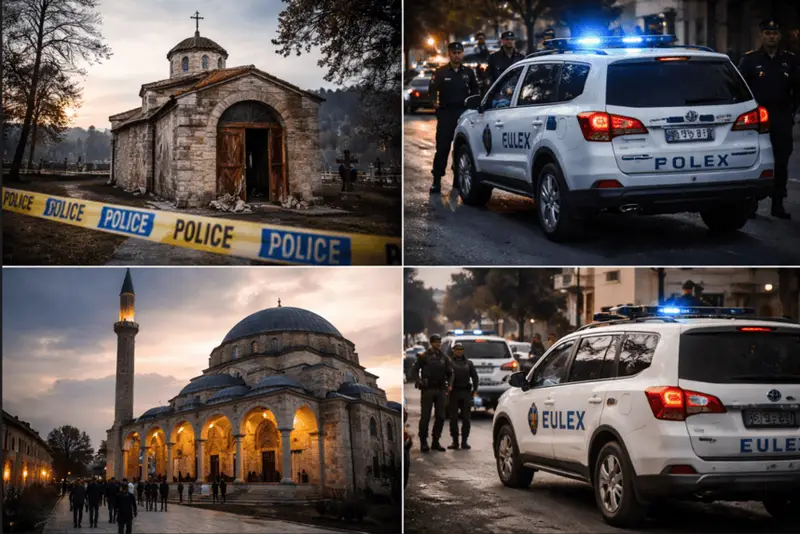
Islamic sites experienced more than double the number of incidents compared to Orthodox sites, contradicting narratives of systematic targeting.
The Nature of the Incidents
The majority of incidents involve criminal property offenses rather than ideologically motivated attacks:
- Aggravated theft: 41 cases in 2023
- Attempted aggravated theft: 8 cases
- Simple theft: 4 cases
Altogether, 53 out of 79 cases (67%) were theft-related, emphasizing that these are criminal acts, not religious persecution.
Serbia’s Inflation of Numbers
The most striking disparity appears when comparing Kosovo Police data with Serbian official claims:
| Year | Serbia Claimed | Kosovo Police | Inflation Ratio |
|---|---|---|---|
| 2023 | 179 | 23 | 7.8× |
| 2024 | 124 | 16 | 7.7× |
| 2025 | 132 | 8 | 16.5× |
The gap is not a rounding error—it represents systematic inflation of incidents for political effect.
Political Context of Multiplication
Analysts suggest that inflated figures serve strategic purposes:
- Reinforce Serbia’s protective claim over Kosovo Serbs
- Frame Kosovo as unstable in front of EU mediators
- Recast a political dispute as a religious emergency
- Exert pressure on Brussels through moral urgency
While perceptions of insecurity are understandable given Kosovo’s complex history, international monitoring missions, including EULEX, OSCE, and KFOR, report no evidence of systematic persecution at the scale claimed.
The Reality
The arithmetic speaks for itself:
- Total incidents are declining: 79 → 53 → 28
- Orthodox incidents over three years: 47
- Islamic incidents over three years: 102
- Majority theft-related: ~67%
- Inflation ratio: up to 16.5× higher than official records
Rather than a siege of Orthodox sites, the data reflects ordinary criminality in a monitored, internationally supervised environment. The difference between 23 and 179 is not technical—it is political, demonstrating how numbers can be manipulated to influence perception in conflict narratives.