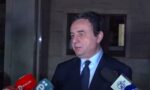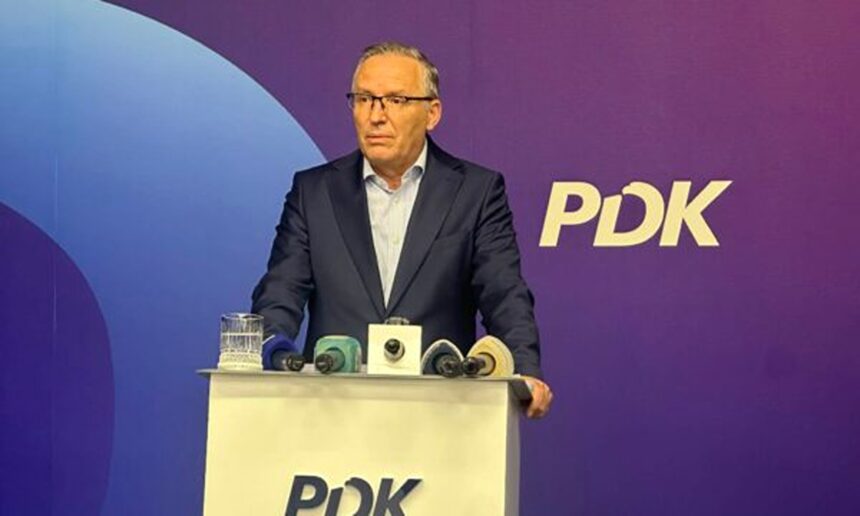
The chairman of the Democratic Party of Kosovo (PDK), Bedri Hamza, held his second meeting today with Prime Minister Albin Kurti to discuss the process of electing the new President.
The meeting took place immediately after a session of the PDK Presidency, where positions were adopted regarding the presidential election process.
At a press conference, Hamza stated that only four days remain until the constitutional deadline for electing the President expires, emphasizing that the responsibility lies with Vetëvendosje (LVV).
“The responsibility for this process is clear and undisputed: it belongs to the largest party and the parliamentary majority leading the country. Those who have the mandate to govern also have the obligation to ensure the election of the President,” he said.
Hamza stressed that PDK has acted with maturity and responsibility.
“We removed red lines because I have always considered them harmful to the consolidation of institutions and the political stability of the country. We have never excluded the possibility of a comprehensive political agreement, if it would serve to avoid new elections and preserve stability. We entered meetings to discuss a consensual President.”
He added that he accepted the first meeting with Kurti believing there was sincere will for a unifying figure — specifically a member of the emblematic Jashari family, who would represent national unity and have PDK’s full support.
After the public statement by the Jashari family, Hamza said circumstances changed.
“Today, in the second meeting I had with Mr. Kurti, following the Presidency meeting earlier in the day, PDK offered one concrete and final opportunity to avoid new elections: we requested that a President proposed by PDK be elected, as a solution to guarantee institutional stability and overcome the political deadlock. With this offer, made in a spirit of responsibility and to prevent the country from falling into unnecessary crisis, the PDK Presidency considers our contribution to this process fulfilled.”
Hamza noted that two months have passed since the December 28 elections and more than two weeks since the vote on Kurti’s third government, with only four days remaining before the constitutional deadline expires.
“In this time frame, it is legitimate to ask whether last-minute meetings are genuinely aimed at finding a solution, or at artificially narrowing time in order to shift pressure onto the opposition. Such an approach would be inappropriate for a process of this importance, directly linked to political stability and the normal functioning of state institutions.”
He said it remains to be seen whether the parliamentary majority — and Kurti in particular — will seriously reflect to avoid new elections, or whether PDK’s readiness and constructiveness will be treated as an opportunity to shift responsibility rather than as a basis for a genuine solution.
“I hope the former prevails.”
Hamza emphasized that PDK has demonstrated what a responsible opposition should: political will, participation in meetings, clear positions, and readiness for solutions in the country’s interest.
“We cannot and will not assume responsibilities that do not belong to us. We cannot cover their lack of numbers. We cannot compensate for their lack of decision-making. And we cannot replace the parliamentary majority. We are the opposition. And we will behave as the opposition: critical when the public interest is harmed, and clear when responsibility is being shifted.”
He added that PDK is not an obstacle to state processes.
“Responsibility for producing results falls on the government and its majority, because the opposition has a supervisory role, not a rescue role.”
In closing, Hamza said Kosovo needs a President, functional institutions, and stability — but above all, it needs a parliamentary majority that carries the weight of responsibility beyond short-term calculations and political games.
“PDK will continue to be a serious, responsible, and unwavering opposition in defending the state’s interest. We have done our part. From today onward, responsibility lies solely with those who govern. Those who received the citizens’ trust and have the ability to reach consensus must not misuse it,” Hamza concluded.