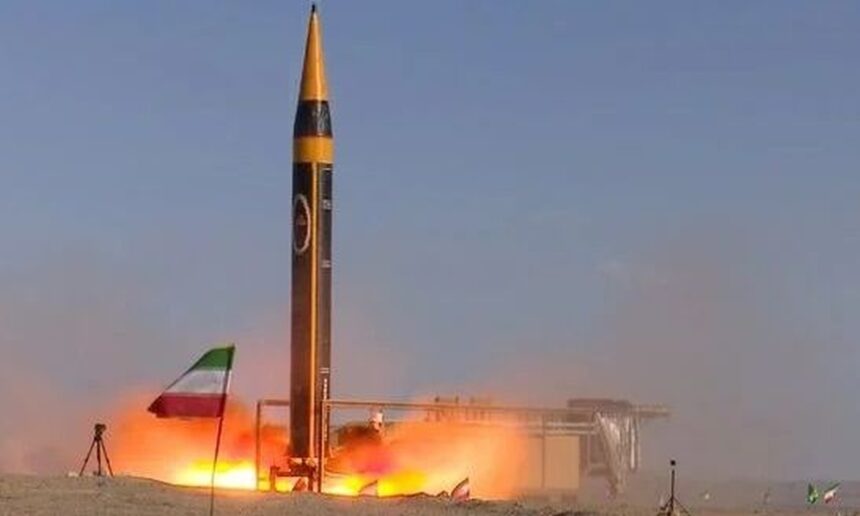
Former head of Israel’s air defense, Ran Kochav, explained to The Jerusalem Post how Iran doubled the range of its ballistic missiles overnight.
For years, both Israel and the United States have warned that Iran’s satellite tests could include dual-use elements capable of developing intercontinental ballistic missiles (ICBMs), both conventional and nuclear.
The launch of an Iranian ballistic missile with a range of roughly 4,000 kilometers—exceeding the 2,000-kilometer range that much of the world had expected—likely resulted from a two-stage launch process, similar to satellite deployment, Kochav told The Jerusalem Post on Sunday.
Kochav noted that the launch “doubled Iran’s proven capability overnight” to target U.S. and British bases in Diego Garcia in the Indian Ocean.
Echoing the statement of IDF Chief of Staff Eyal Zamir on Saturday evening that the additional range likely came from a multi-stage launch vehicle, Kochav emphasized that Iran has spent years developing two-stage launch technology to test satellite deployment into space.
For years, Israel and the U.S. have warned that Iran’s satellite tests could have dual-use applications, enabling the development of intercontinental ballistic missiles, conventional or nuclear.
While the Islamic Republic has always denied this possibility, the Saturday launch may have revealed a secret program that has operated for years specifically for such purposes.
Modified R-27 Ballistic Missile from the Soviet Era
Discussing potential scenarios, Kochav—later also the IDF’s main spokesperson—suggested the missile type might have been a modified R-27 ballistic missile from the Soviet era. The R-27 was primarily launched from Soviet submarines and could carry nuclear payloads, but Iran may have modified it for land-based launches.
Kochav noted that North Korea has used a missile with a similar technological background, demonstrating a range of about 3,000 kilometers.
If the missile were from the R-27 family, Kochav said it would typically carry a 1.5–2 ton warhead. One way the range could have extended from 3,000 to 4,000 kilometers would be if a secret program were operating to launch the missile with a much lighter warhead.
In other words, a lighter warhead reduces the missile’s weight, allowing it to travel farther using the same energy and a similar launch process, potentially achieving intercontinental ballistic missile capability once two-stage launch proficiency is achieved.