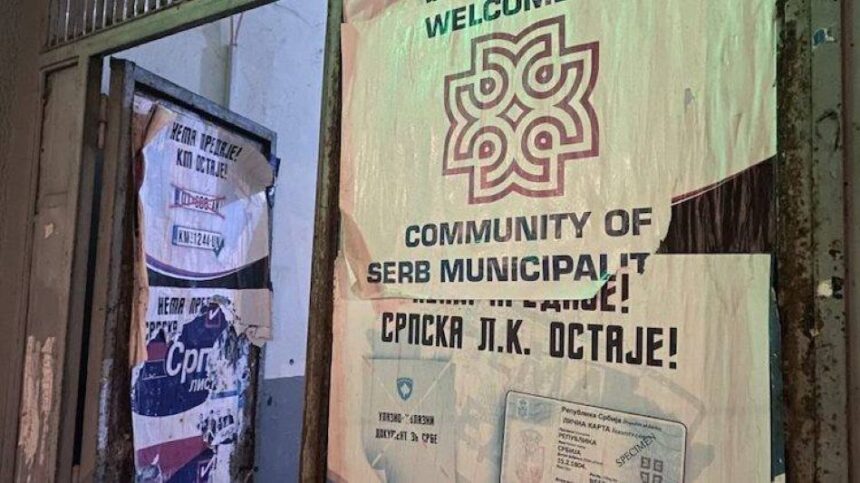
Three years after the draft statute for the Association of Serb-Majority Municipalities was presented to Kosovo and Serbia, the document remains where it has always been: in a drawer, unsubmitted to the Constitutional Court, generating diplomatic friction without producing diplomatic resolution. What has changed in recent days is not the substance of the impasse but the register in which Western frustration is being expressed — and the number of capitals expressing it simultaneously.
That simultaneity is itself the story. Within the span of a week, the EU’s outgoing head of mission delivered a public admission that the current approach has failed, the German and French ambassadors made direct representations to Pristina, German Chancellor Friedrich Merz and French President Emmanuel Macron embedded substantive demands inside congratulatory letters to a newly re-elected prime minister, and EU Special Envoy Peter Sorensen flew to Washington to align positions with the State Department. None of this amounts to a new policy. All of it signals that the old one has run out of road.
Letters with teeth
Congratulatory letters between heads of government are, as a genre, exercises in warm imprecision. The letters Merz and Macron sent to Prime Minister Albin Kurti following his re-election were something else.
Merz dispensed with ceremony early. “Challenging tasks lie ahead of you and your government,” the German chancellor wrote, in a letter published by the Prime Minister’s Office. “I am convinced that, with your experience, you will take the right and necessary decisions for the further Euro-Atlantic integration of Kosovo. This also includes further progress in the EU-mediated normalization dialogue with Serbia.” The framing — Euro-Atlantic integration as the goal, dialogue progress as the price — is the standard Berlin formulation. What is less standard is delivering it in a congratulatory note, in the first days of a new mandate, before the government is fully constituted.
Macron’s letter was sharper. Where Merz spoke of “further progress” — a phrase that can absorb almost any definition — the French president named the legal architecture. The Brussels and Ohrid Agreements, he wrote, “have set the direction, and it is up to both sides to fulfill the commitments made within the framework of the EU-facilitated dialogue.” France would “tirelessly” support normalization as “an essential dimension” of Kosovo’s European path.
The phrase “both sides” is carrying weight that is easy to miss. It is Macron’s most explicit public acknowledgment that Serbia, too, holds unfulfilled obligations — and it provides Pristina a sliver of diplomatic cover to insist on reciprocity before moving. But the structural pressure lands where it always does. The Ohrid framework is the operative reference. Ohrid includes the Association. Kurti knows this. So does Paris.
The envoy’s admission
The more consequential statement of the week came not from a head of government but from a departing ambassador. Aivo Orav, the EU’s outgoing head of mission in Pristina, told journalists from Serbian-language media what three years of careful institutional language had avoided saying directly: the current approach is not working, and the EU knows it.
“If I know that the draft statute will not be sent to the Constitutional Court,” Orav said, “then no one benefits from such a position.” He confirmed that the Association obligation does not dissolve with a change in government status — caretaker or full mandate makes no difference to what Kosovo has committed to. And then he said something that should have received more attention than it did: “In diplomacy, we must find ways to address these issues.”
That sentence is a policy vacancy dressed as diplomatic flexibility. Orav is acknowledging, in the measured language available to him, that the EU does not currently have a credible mechanism to move this issue. The Association is alive as a legal obligation, as a dialogue commitment, as a reference in every congratulatory letter from Paris and Berlin — but the instrument capable of converting that obligation into action has not been identified. Finding it is now someone else’s problem. Orav is leaving.
German Ambassador Rainer Rudolf added a complementary pressure point, confirming to RTK that Berlin had directly communicated to Kurti that it “would greatly appreciate” a positive signal toward establishing the Association. His parallel remarks on the Law on Foreigners — urging implementation that would not damage health and education services for minority communities — were carefully bounded. Rudolf did not challenge the law’s legitimacy. He challenged its consequences. The distinction matters: it signals German restraint on the sovereignty question while maintaining pressure on the humanitarian one.
What the statute actually says
The legal dimension of the Association debate has been flattened in most coverage into a binary — Kurti implements or Kurti refuses — that obscures the genuine constitutional complexity underneath.
Diplomat Alberit Prenkaj, in a detailed Facebook post that circulated widely this week, laid out the architecture more precisely. The Association was an obligation under the Ahtisaari document, he noted, but the 2023 Kurti-Vučić agreement materially changed what was being obligated. Where Ahtisaari envisioned decentralized administrative autonomy for Serb-majority municipalities, the 2023 draft statute introduced something closer to concentrated self-governance — a shift in kind, not merely degree. This is not a trivial distinction. A statute granting concentrated autonomy to an ethnically defined municipal grouping sits differently against Kosovo’s constitutional framework than one providing decentralized administrative coordination.
This is precisely why sending the statute to the Constitutional Court is not a concession, Prenkaj argued — it is the legally required procedure, agreed to explicitly in the 2015 Isa Mustafa-Vučić agreement brokered by Federica Mogherini. The Court’s 2015 ruling found the Association as then conceived incompatible with the constitution. A new review of a revised statute is not a replay of that verdict — it is the mechanism by which unconstitutional elements can be identified and stripped before implementation. “Cleansed of unconstitutional elements,” Prenkaj wrote, the statute “must become functional law in Kosovo.”
He also offered the sharpest framing of recent events available in the public debate: Kurti’s effective acceptance of documents issued by parallel Serbian institutions — structures agreed to be dissolved under the 2013 Brussels Agreement — constitutes a quiet capitulation that Brussels has papered over by reviving high-level dialogue rhetoric. The Association is being used, he suggested, to rehabilitate the EU’s regional presence after a period of diminished influence, rather than to genuinely resolve the underlying dispute.
The conditional at the center
Political analyst Nexhmedin Spahiu, speaking to Kosovo Online, provided the most direct account of why the Association has not moved in three years despite sustained Western pressure. Kurti, he argued, has treated the Association not as an isolated obligation but as one element in a package that must include the opening of permanent diplomatic missions — Kosovo in Belgrade, Serbia in Pristina — which would represent de facto and de jure recognition of Kosovo’s independence.
If this reading is accurate, then no amount of diplomatic pressure focused solely on the Association will produce movement, because Kurti is not holding the Association hostage to intransigence. He is holding it hostage to a condition that no Western government has been willing to publicly endorse, and that Serbia has not been willing to meet. The EU’s framing — implement the Association, and dialogue will produce results — assumes a sequencing that Kurti does not accept.
Spahiu added that Kurti’s caretaker status is not a negotiating asset but a liability, the product of a presidential election miscalculation in which he expected opposition parties to fear early elections and found instead that they welcomed them. “He bluffed,” Spahiu said flatly. “He thought the opposition would fear elections. But they did not fall for it.” The government that will eventually face this accumulated Western pressure may do so from a weaker domestic position than the one Kurti had anticipated holding.
The opposition’s dare
Former Foreign Minister Enver Hoxhaj, now a PDK deputy, used a television appearance this week to make an argument that is less about the Association than about who controls the dialogue question going forward.
Hoxhaj’s central charge was procedural: the government has conducted the dialogue without parliamentary accountability, using the Law on Foreigners as cover for decisions the Assembly should be debating openly. A new Assembly resolution on the dialogue was needed, he said, to establish what Kosovo had actually agreed to and what it had not.
But it was his offer to Kurti that defined the appearance. If the prime minister brings the draft statute to the Assembly for formal rejection, PDK will provide its signatures. The invitation is calibrated to be either irresistible or impossible: if Kurti accepts, the Assembly owns the outcome; if he refuses, he confirms that he is avoiding democratic accountability on the question. Either way, PDK positions itself as the party willing to have the vote that Kurti is not.
Washington: alignment, but on what
The transatlantic dimension of the Association impasse sharpened this week in ways that deserve more attention than they have received.
EU Special Envoy Peter Sorensen met in Washington with Brendan Hanrahan, Senior Bureau Official at the State Department’s Bureau of European Affairs. Sorensen described the meeting on X as covering the dialogue, “recent achievements,” and alignment on next steps. The language is anodyne enough to be unrevealing, but the meeting itself is not. Sorensen is not a figure who makes courtesy calls to mid-level State Department officials. The visit signals that he is working actively to ensure that whatever new approach the EU develops has American awareness before it is announced — and that the phrase “aligned our views” reflects a process still underway rather than a conclusion already reached.
The meeting is best read alongside a separate engagement reported this week: the Albanian American Relations Council held a nearly two-hour meeting with three State Department officials, including Andrew Caruso, who has assumed the Kosovo portfolio following Anne Morrison’s departure. AARC pressed the State Department on what it described as fifteen years of EU-facilitated process with limited results, arguing that real progress would require a U.S.-led framework with mutual recognition as the explicit central objective. The State Department’s emphasis, in response, fell on investment climate, energy, and mining — an economic framing of U.S. interest that sits uneasily alongside the normalization urgency that both the EU and Kosovo’s opposition are invoking.
Sorensen’s Washington visit may reflect a concern that this economic framing, left unchallenged, could gradually displace normalization from Washington’s active agenda. If the U.S. is focused on minerals and the EU is searching for a new mechanism and Kurti is waiting for conditions that have not been met, the dialogue has three actors each operating on a different timeline — which is, functionally, no dialogue at all.
What this moment amounts to
The coordinated Western messaging of the past week is real. So is its limitation. Merz and Macron have invoked legal frameworks. Orav has admitted failure. Sorensen has flown to Washington. Rudolf has called for a signal. And Kurti, who has absorbed two full mandates of this pressure without altering his fundamental position, is now governing from a weaker domestic footing with the same strategic calculation intact: that the costs of implementing the Association exceed the costs of not implementing it.
Nothing in the current diplomatic environment has changed that calculation. The letters from Paris and Berlin are more pointed than previous iterations, but they are still letters. Orav’s admission is more candid than previous EU statements, but he is leaving. Sorensen’s Washington meeting produced aligned views on next steps that have not been specified. The opposition has offered Kurti a parliamentary procedure he has not accepted.
What Western diplomacy has produced this week is a clearer articulation of the problem. What it has not produced is a lever capable of solving it. Until that lever exists — whether it takes the form of conditionality with real consequences, a U.S.-led framework that changes the negotiating geometry, or a domestic political realignment that shifts Kurti’s incentive structure — the Association will remain where it has been for three years: legally obligated, politically suspended, and diplomatically exhausted.