The arms race has existed for centuries, but after World War II it became global and systematic, particularly between the United States and the Soviet Union during the Cold War. Nuclear weapons, ballistic missiles, and combat aircraft transformed the concept of military power in the decades that followed.
Today, developments in the Western Balkans, especially in Serbia, are sending serious warnings.
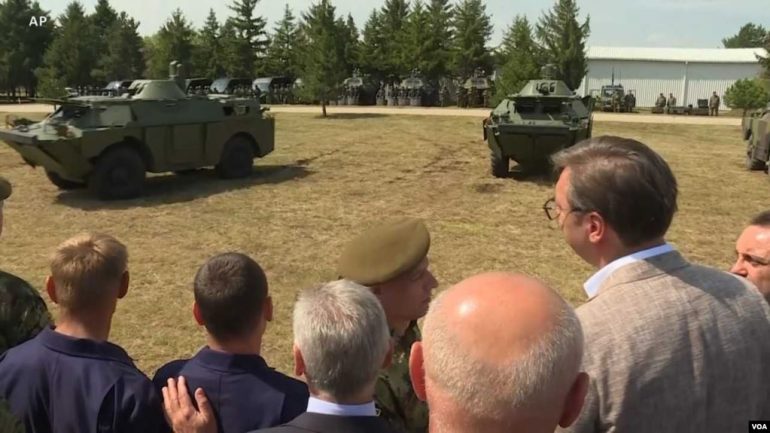
Serbia—a NATO partner and EU candidate—recently acquired supersonic ballistic missiles from China for its air force, becoming the first country in Europe equipped with the CM-400AKG air-to-ground missiles, according to Serbian President Aleksandar Vučić.
“We have successfully integrated Chinese missiles onto fourth-generation Russian MiG-29 aircraft. These are now among the best planes in Europe—perhaps even in the world. Air-to-ground missiles mean hitting targets on land with destructive power,” Vučić said on March 12.
The move drew strong reactions from neighbors that fought against Serbia during the 1990s Yugoslav wars.
Croatia—now a NATO and EU member—viewed the acquisition as a threat to regional stability and a sign of an escalating arms race in the Balkans. Kosovo accused Serbia of hegemonistic intentions toward its neighbors.
Kosovo, Croatia, and Albania signed a defense and security cooperation agreement in March 2025, which Vučić perceives as a direct security threat to Serbia. “There is no other reason for their union—only Serbia matters,” he stated, warning of potential attacks.
Vučić offered no evidence for these claims, which Zagreb, Pristina, and Tirana consistently reject. He only mentioned that the Serbian armed forces also possess other sophisticated weapons that cannot be disclosed publicly.
Security and military analysts say these statements raise fear and uncertainty in the region, increasing perceived threats and prompting neighboring countries to strengthen defensive capabilities. This dynamic could easily escalate into a new arms spiral, where each action produces a counteraction, further heightening tensions.
Redion Qirjazi, a security expert in Albania—a NATO member—notes that Chinese missiles give Serbia new power projection capabilities and shift the regional security balance. “These missiles are not just for defense; they extend military reach over long distances. They are highly precise and extremely fast—around Mach 4 to Mach 5, or up to 6,000 km/h—making them very difficult to intercept,” he told Radio Free Europe’s Expose program.
Serbia maintains open tensions with Kosovo, with ongoing territorial disputes, and sporadically with Montenegro, while relations with Albania and North Macedonia are calmer. Its connection with Republika Srpska in Bosnia and Herzegovina remains a distinct case.
According to Kadri Kastrati, a military expert from Kosovo, Serbia’s arms acquisitions clearly demonstrate its intent to position itself as the most heavily armed and dominant actor in the Balkans, keeping the region on edge.
“This arms race is, above all, competition with Croatia. After Croatia received Rafale fighter jets from France, Vučić arranged deals with President Emmanuel Macron for the same planes—essentially a direct competition,” Kastrati said.
Despite claiming military neutrality, Serbia has the most expensive army in the Western Balkans. In 2024, it spent $2.2 billion—about five times more than Albania, the second-highest spender and a NATO member. Serbia also spends significantly more than Croatia, with differences in defense budgets reaching hundreds of millions of euros annually, according to the Stockholm International Peace Research Institute (SIPRI).
Following Russia’s invasion of Ukraine, Serbia diversified its arms sources, turning to China for combat drones and FK-3 air defense systems while continuing purchases from Western countries, including the U.S. and France.
Vučić particularly emphasizes the Croatian military. When Serbia acquired Rafale jets in 2024, he remarked that when Croatia does the same, it’s “good news for the region,” whereas Serbia’s purchases become “a tragedy.”
“We are not creating problems anywhere, nor planning or targeting them. This is a strong signal of trust between France and Serbia. We only want to protect our country,” Vučić said.
Katarina Gjokiq, a researcher at SIPRI, cautions that comparisons between Serbia and Croatia must be considered carefully. Croatia, as a NATO member, plans its military capabilities within the alliance framework, while Serbia operates outside this system.
She adds that political elites often use neighbors’ armaments to justify expanding their own military power.
“This is worrying in the context of Serbia, Kosovo, and Croatia—the reckless rhetoric by political elites increases tensions instead of using existing regional mechanisms for communication and problem-solving,” Gjokiq said.
Qirjazi warns that such an environment of tension and mistrust can lead to miscalculations and hasty, uncontrolled responses—a situation he defines as a “miscalculation.”
“We have seen this in the recent Iran-Israel-U.S. conflict, where the claim was that Iran would strike first, so a preemptive attack occurred. Similarly in Iraq, it was argued that Saddam Hussein would create and use weapons of mass destruction, prompting action. This is the security spiral and escalation,” he explains.
In response to Serbia’s missile acquisitions, the EU emphasized that the country must make clear strategic choices on its path toward integration. NATO, Serbia’s partner, did not comment on its ongoing collaboration with Beijing.
In May, NATO will conduct joint military exercises with Serbia at the Borovac training ground near the Kosovo border. The NATO Joint Forces Command in Naples stated that the exercise, held at Serbia’s invitation, strengthens practical cooperation and supports stability in the Western Balkans.
For Qirjazi, this reflects Serbia’s “multi-door strategy”: engaging China to increase regional influence while cooperating with the West to create mutual dependence.
“This strategy was also characteristic of former Yugoslavia under Tito, who maintained multiple strategic partnerships and alliances to create dependence from global powers,” he notes.
Gjokiq agrees but adds that cost is also a factor: countries often acquire Chinese arms because they are cheaper. Serbia’s European location gives it unique considerations and expectations.
Vučić did not disclose the cost of the CM-400AKG missiles, capable of carrying up to 200 kg of explosives, but described them as “very expensive.”
According to the latest SIPRI report, arms purchases in Europe have increased significantly, making the continent the largest arms importer, with a 210% rise between 2016-2020 and 2021-2025. The U.S., meanwhile, dominates arms exports, with Kosovo among its many clients.
Kosovo defense officials stress that all arms acquisitions are made exclusively through NATO allies.