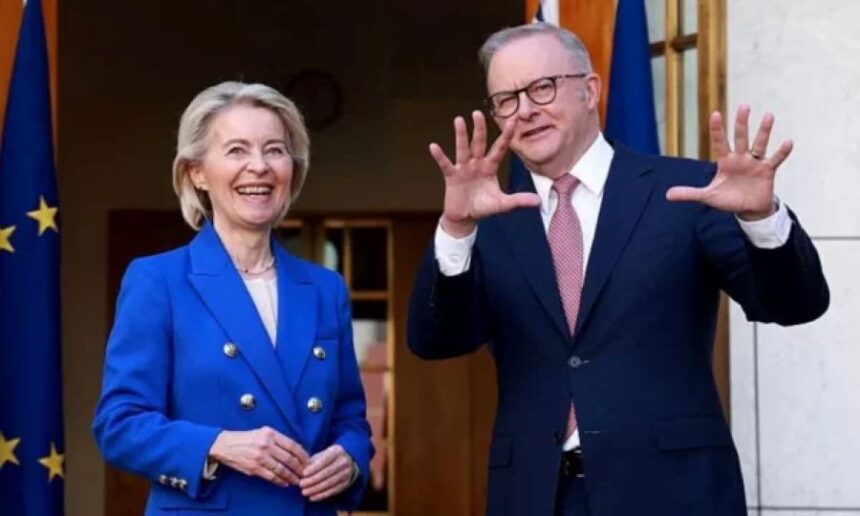
Australia and the European Union have concluded a comprehensive free trade agreement after eight years of negotiations. Valued at around 10 billion Australian dollars (7 billion USD; 5.2 billion GBP), the deal was signed on Tuesday, with Australian Prime Minister Anthony Albanese and European Commission President Ursula von der Leyen describing it as a mutually beneficial “win-win” outcome, according to BBC, cited by Gazeta Express.
In addition to removing nearly all tariffs, the agreement also strengthens cooperation on defense and critical minerals.
Von der Leyen emphasized that the deal reflects “collective sustainability” in a world undergoing profound change. “This is a world where major powers use tariffs as leverage and supply chains as vulnerabilities,” she said, referencing actions by former U.S. President Donald Trump and China’s control over critical mineral markets. She added that “trust matters more than transactions,” highlighting the unique, long-term relationship between Australia and the EU.
Key Provisions: Agriculture, Wine, and Defense
The agreement eliminates nearly all EU tariffs on Australian agricultural exports such as wine, fruits and vegetables, olive oil, seafood, most dairy products, wheat, and barley. This is expected to save Australian producers and exporters approximately 37 million AUD annually.
For Australian consumers, the deal means lower prices for European wine, alcoholic beverages, cookies, chocolate, and pasta.
Australian sparkling wine in the Italian style can continue to be sold domestically as “prosecco,” though the name will be phased out gradually for exports over ten years. Australian producers can also continue using names like “parmesan,” while “feta” will follow special transitional rules. Australia is now the only country outside Italy authorized by the EU to use the name “prosecco.”
Prime Minister Albanese highlighted the cultural significance of these products, noting that Australia’s modern history is built by immigrants producing foods like feta, parmesan, and kransky sausages.
Von der Leyen described the agreement as a “perfect balance,” facilitating Australian exports to the EU while increasing European products available in Australia.
However, Andrew McDonald from Meat and Livestock Australia noted that the agreement’s meat export provisions fell short of farmers’ expectations. While Australian producers had requested an annual quota of at least 50,000 tons, the deal allows only around 30,000 tons, up from 3,389 previously. “This is undoubtedly a missed opportunity for Australian red meat producers, processors, and exporters,” he said.
The agreement also establishes a new security and defense partnership, enhancing cooperation in defense industries, counterterrorism, space, and maritime security. Von der Leyen announced further collaboration on critical mineral projects, including lithium and tungsten, between Australia and the EU.