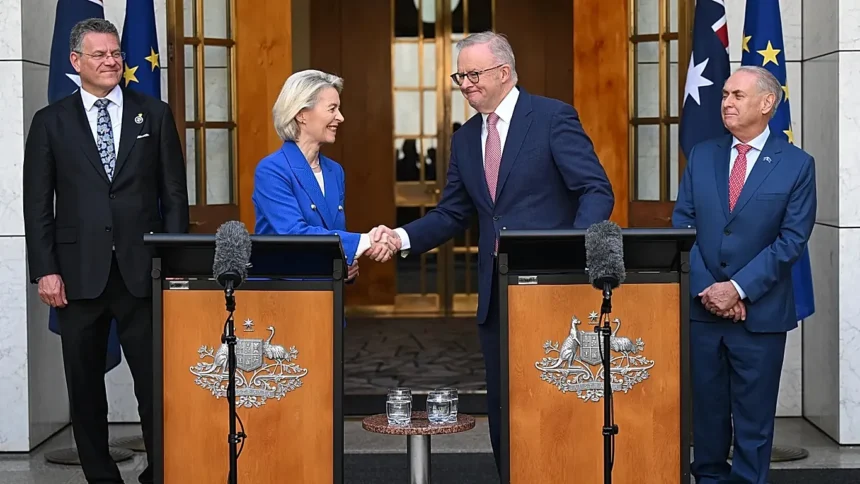
After nearly a decade of talks, the European Union and Australia have finalized a comprehensive free trade agreement aimed at boosting economic ties and reducing tariffs across key sectors.
Ursula von der Leyen and Anthony Albanese announced the deal this week, highlighting its strategic importance amid shifting global trade dynamics and efforts to reduce dependence on China.
The agreement will eliminate tariffs on a wide range of European exports to Australia, including wine, chocolate, pasta, and cheese, making these products more affordable for Australian consumers. In return, Europeans will benefit from cheaper imports of Australian seafood, nuts, and agricultural goods.
A key provision includes stronger protection for geographical indications, ensuring that products like Champagne and Pecorino Romano retain their authenticity and branding in the Australian market.
The deal also opens new opportunities for the automotive sector, with reduced barriers expected to boost exports from major European manufacturers such as BMW, Mercedes-Benz, and Porsche.
Beyond consumer goods, the agreement has significant geopolitical implications. It removes EU tariffs on critical minerals like lithium and manganese—essential for electric vehicles and renewable technologies—while also enhancing cooperation on clean energy, including hydrogen.
However, the deal has sparked concern among European farmers, particularly over increased imports of Australian beef and agricultural products, which could intensify competition in the EU market.
Overall, the agreement is expected to increase EU exports to Australia by up to one-third and save businesses more than €1 billion annually in duties, marking a major step forward in global trade cooperation.