Brussels continues to intensify its political scrutiny of Serbia, as members of the European Parliament openly accuse the government in Belgrade of democratic backsliding, corruption, and institutional violence.
European Parliament member Irena Joveva stated that Serbia under President Aleksandar Vučić has been marked by “violence, corruption, and state capture,” arguing that the country needs a fundamental political change.
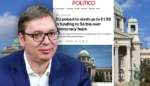
Her comments were made in response to recent reporting by Politico, which suggested that Serbia could face the suspension or reduction of up to €1.5 billion in EU financial assistance due to concerns over democratic standards and its foreign policy alignment with Russia.
Growing pressure from the European Parliament
Joveva’s remarks reflect a broader shift among some members of the European Parliament, particularly within the Renew Europe group, who are increasingly vocal about Serbia’s political trajectory.
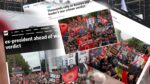
She described Serbia’s current situation as the result of “stolen elections and weakened media freedom,” and expressed support for opposition protests and student-led movements in the country. Joveva has previously criticized EU institutions for what she sees as an insufficient response to developments in Serbia.
Calls for suspension of EU funds
Another Renew Europe MEP, Sandro Gozi, went further by calling for urgent action from the European Commission, including the possible suspension of EU funding to Serbia.
Gozi argued that worsening conditions at universities, alleged pressure on the judiciary, and concerns about electoral fairness justify stronger EU intervention. He said financial leverage should be used to push for reforms ahead of any future elections.
Link to EU enlargement policy
The debate in the European Parliament comes as the European Commission, led on enlargement policy by Marta Kos, is reportedly reviewing Serbia’s eligibility for continued financial support under EU pre-accession instruments.
According to EU officials cited by Politico, Serbia’s democratic performance and alignment with EU foreign policy—particularly regarding Russia—are key factors in ongoing assessments.
Kos has previously warned that Serbia is facing increasing concerns in Brussels related to rule of law, media freedom, and the treatment of protests and opposition groups.
Serbia’s geopolitical balancing act
Serbia has long pursued a dual-track foreign policy: maintaining EU accession ambitions while preserving close ties with Russia and China. This balancing act is now increasingly under scrutiny in Brussels.
Critics argue that this approach is becoming harder to sustain as EU institutions move toward stricter conditionality on funding and membership progress.
Rising political tension between Belgrade and Brussels
The growing criticism from EU lawmakers reflects a broader hardening of attitudes toward Serbia within parts of the European Union. While official enlargement policy remains conditional and procedural, political discourse in the European Parliament is becoming more confrontational.
For Serbia, the pressure is now both financial and political: continued access to EU funds, as well as the credibility of its membership path, are increasingly tied to reforms in governance, media freedom, and foreign policy alignment.