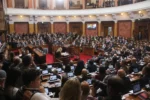
Serbia’s newly elected parliament convened for its first session on Tuesday, marking a major shift in the country’s political landscape as the Studentska Lista movement secured a parliamentary majority for the first time in 14 years, ending the dominance of the Serbian Progressive Party (SNS) under Aleksandar Vučić.
All 250 MPs were sworn in following the October 25 snap parliamentary elections. Studentska Lista won 140 seats, Vučić’s coalition secured 103, while minority parties obtained the remaining seven mandates.
The new parliamentary group includes university professors, scientists, lawyers, doctors and actors, many of whom have little or no previous experience in professional politics. The movement emerged from student-led and civic protests that have shaped Serbia’s political scene over the past two years.
“This was the first day of liberating institutions,” said Jovo Bakić, head of the Studentska Lista parliamentary group, after the session.
Before proceedings began, supporters of the movement gathered outside parliament to welcome their representatives. Their arrival was accompanied by celebrations, while SNS MPs were met with whistles and protests.
Feđa Dimović, an MP from Studentska Lista, said the public reception reflected the expectations placed on the incoming representatives and the responsibility that came with their electoral victory.
The two largest parliamentary groups have appointed their leadership. Bakić heads the Studentska Lista group, with Aleksandra Štimac as his deputy. Vučić, meanwhile, has taken charge of the parliamentary group “Serbia Wins,” with Milenko Jovanov serving as his deputy.
The movement has nominated Aleksandar Čupić for Speaker of the National Assembly, while the SNS has put forward Stojan Radenović, the oldest member of parliament, who presided over the constitutive session.
Presenting Čupić’s candidacy, Studentska Lista MP Jugoslav Gašić described the election result as a fundamental shift in Serbia’s political balance, noting that the movement had received the support of more than 2.3 million voters.
The session was also marked by a lengthy speech from Vučić, who has moved into the opposition following his coalition’s electoral defeat. Speaking for approximately one hour and 40 minutes, he criticised Studentska Lista, claiming that its representatives had nothing to offer citizens beyond “yoghurt and hatred.”
He also addressed an incident outside parliament in which SNS MP Lidija Vukićević was splashed with yoghurt, describing it as a “brutal attack.” Vučić said he had found the movement’s victory deeply upsetting, while also claiming that European leaders had congratulated him on his conduct following the election.
After the speech, Bakić raised a procedural objection, criticising the session’s presiding officer, Radenović, for failing to warn Vučić despite what Bakić described as a departure from the parliamentary agenda.
Bakić later said Studentska Lista MPs had deliberately avoided interrupting Vučić, arguing that they did not want parliament to become an undignified arena for political confrontation. He also questioned Radenović’s suitability to become Speaker, citing his handling of the session.
The election of the new Speaker is expected to be followed by the formation of parliamentary committees and other institutional bodies.
Government formation and possible EU referendum
With the new parliament constituted, Studentska Lista faces the next major task of forming a government. Until a new cabinet is elected, the outgoing administration led by caretaker Prime Minister Đuro Macut will remain in office.
The movement has not yet announced its candidate for prime minister or the proposed composition of the new government. A 90-day deadline for electing a new cabinet has begun following the constitution of parliament.
Human rights lawyer and Studentska Lista MP Sara El Sarag told The Guardian that the student movement remains actively involved in selecting future ministers.
“We are here because of them. We are working together all the time,” she said.
Representatives of the movement have also raised the possibility of holding a referendum on Serbia’s membership of the European Union before 2031.
Ana Dimitrijević, a Studentska Lista parliamentary candidate, told the Brussels-based outlet The Reporter that a referendum should follow reforms to the judiciary, the rule of law and media freedom.
“We will have to hold a referendum. We will have to ask the citizens,” she said.
Psychology professor and Studentska Lista candidate Aleksandar Baucal also expressed the expectation that such a vote could take place during the new parliament’s mandate.
However, the movement has not yet decided whether it would recommend that citizens vote in favour of EU membership. Baucal said the movement was currently united around the goal of building a functioning state and society.
Moscow alleges EU interference in Serbia’s political transition
As Studentska Lista discusses the possibility of an EU membership referendum, Russia has accused Brussels of seeking to influence the political direction of Serbia’s incoming government.
Russia’s Foreign Intelligence Service (SVR) claimed that EU leaders were concerned about the movement’s alleged unwillingness to follow Brussels’ instructions.
In a statement carried by Russia’s Foreign Ministry, the SVR said European officials were particularly concerned about Studentska Lista’s positions on Kosovo, Republika Srpska and its opposition to imposing sanctions on Russia.
The Russian agency further alleged that European intelligence services had been instructed to identify independent student leaders in order to discredit them and create divisions within the movement.
It also claimed that Brussels was prepared to use various forms of influence, including bribery, to encourage Serbia’s new leadership to align itself with EU policy. The statement did not provide publicly verifiable evidence to support these allegations.
Meanwhile, the European Democratic Party welcomed the constitution of Serbia’s new parliament, expressing hope that the political transition would bring the country closer to the European Union.
The party called for a new beginning focused on exposing corruption, strengthening oversight and ensuring justice and accountability after 14 years of Vučić’s rule.
“Serbia deserves democracy and renewed national unity,” the party said, urging the country to move beyond longstanding political divisions.