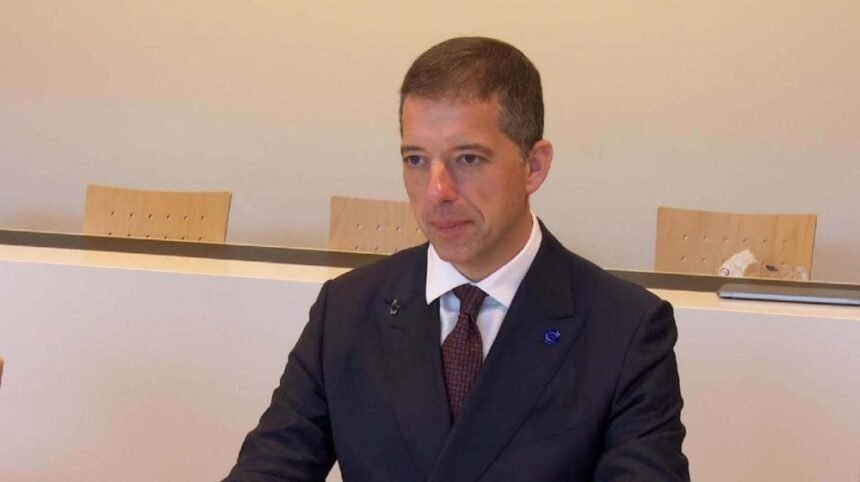
Serbia’s Minister of Foreign Affairs, Marko Đurić, stated that the government remains committed to dialogue and social stability, despite a politically tumultuous year marked by what he acknowledged as “high levels of polarization.”
Speaking after his meeting with German counterpart Johann Wadephul, Đurić emphasized that the government is focused on lowering internal tensions and fostering an environment where diverse views can be expressed.
“We are working on lowering societal tensions and will double our efforts in the period ahead,” Đurić said, responding to accusations from opposition groups and civil society that freedom of assembly in Serbia is being restricted.
Đurić added that 22,000 public gatherings have taken place in Serbia, and “fortunately, none resulted in casualties”, though he admitted that “political violence” occurred in isolated cases, referring to alleged attacks on offices of the ruling Serbian Progressive Party (SNS).
However, observers note that peaceful protesters and political opponents have faced harassment and police intervention, calling into question the degree of freedom Đurić claims is guaranteed.
Criticism and Responsibility
Đurić acknowledged that the current political climate in Serbia is “unhealthy”, urging all political actors to share responsibility in restoring a constructive dialogue.
“We are committed to dialogue based on mutual respect and I am fully confident that Serbia will pass the test of political maturity,” he stated, adding that Serbia aims to show Europe it can handle internal disputes “through institutional methods.”
Addressing U.S. Sanctions on Serbia’s Oil Industry
The minister also addressed the recent U.S. sanctions on Serbia’s oil giant, NIS, due to its majority ownership by Russia’s Gazprom, which has raised concerns over the country’s energy security. He underlined the importance of diversifying energy sources:
“Rest assured, the Serbian government will take all necessary steps to ensure energy supply security for citizens and businesses. We will be holding daily sessions in the coming days to resolve the NIS issue.”
Despite Đurić’s assurances, critics argue that the government’s overdependence on Russian energy and its reluctance to fully align with EU foreign policy continue to jeopardize Serbia’s strategic interests and relations with the West.