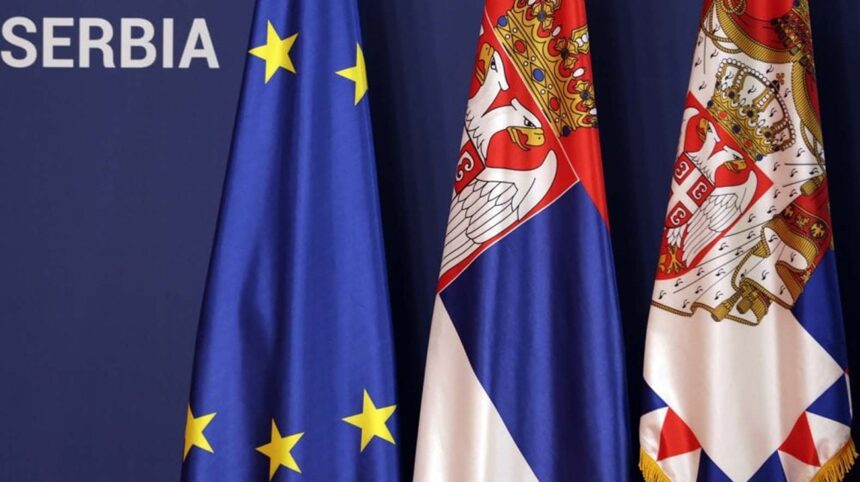
As Serbia edges further from the European Union, the Novi Sad Declaration has emerged as a pointed critique of both President Aleksandar Vučić and the state apparatus he controls. The declaration, highlighted by Goran Ješić, founder of the Solidarity movement, aims to “return to the big doors” of the EU and revive the discussion of European integration in a society where the topic has long been suppressed.
Leadership and Institutional Failures
Analysts argue that Serbia’s lack of progress is a direct consequence of Vučić’s leadership. Despite repeated promises of EU accession, the Serbian president and his administration have systematically obstructed reforms, manipulated public opinion, and used state institutions to consolidate power, leaving Serbia politically isolated from the Union.
Since the outbreak of the war in Ukraine, Serbia has refused to align its foreign policy with EU standards, avoiding sanctions on Russia and delaying the opening of new negotiation chapters. Brussels has repeatedly stressed the necessity of these steps, yet Vučić’s government continues to stall, demonstrating a deliberate disregard for the EU’s conditions.
Erosion of Public Trust
Ivan Lakićević from the Institute for Philosophy and Social Theory notes that state-controlled media under Vučić has systematically undermined public support for EU membership. “Support for joining the EU is now the lowest in the region,” Lakićević explains. “This is not a reflection of public disinterest but a result of deliberate misinformation and propaganda orchestrated by the ruling administration.”
The government’s inaction extends beyond foreign policy: a year after the collapse of the Novi Sad canopy, responsible parties remain unaccountable, highlighting how Vučić and state institutions prioritize political protection over public safety
EU Engagement Driven by External Pressure
Political analyst Miljan Mladenović emphasizes that EU engagement in Serbia is currently driven by Brussels, not by domestic political will. Key reforms in judiciary independence, rule of law, and civil accountability remain stalled, reinforcing the perception that the Serbian state, under Vučić, is unwilling to implement meaningful change.
Novi Sad Declaration: A Demand for Accountability
Drafted by Predrag Filipov, Lidija Piroški, and Professor Milivoj Bešlin, the Novi Sad Declaration demands transparency, accountability, and adherence to democratic principles. It directly confronts both the failures of Vučić’s leadership and the systemic inaction of state institutions, calling for a return to legal, orderly, and civil governance in Serbia.
Conclusion
The Novi Sad Declaration underscores a dual crisis: a political leader prioritizing personal power over national progress, and a state apparatus that enables stagnation and corruption. For Serbia to reclaim a credible path toward the European Union, it must confront not only Vučić’s leadership but also the entrenched institutional failures that have obstructed reform for years.