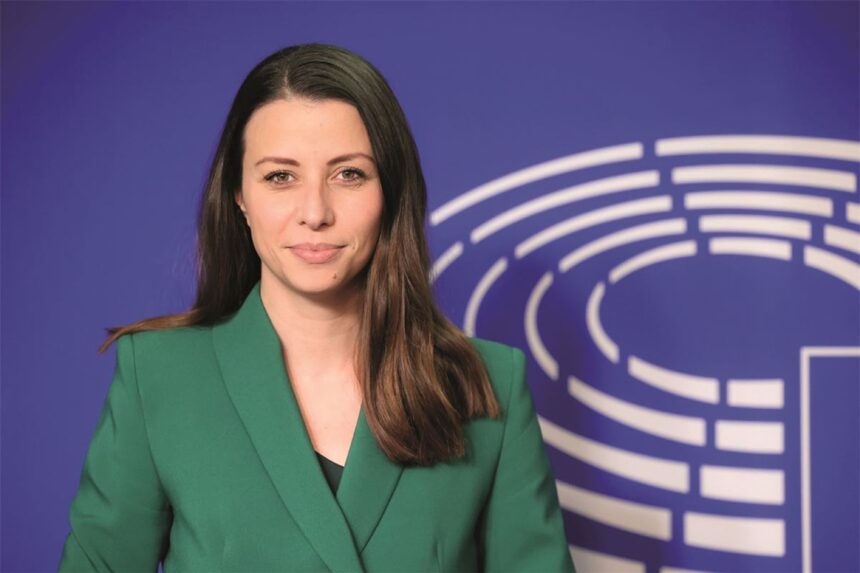
At a time when the Western Balkans faces significant political tensions and challenges in the European Union enlargement process, MEP Irena Joveva spoke about the importance of concrete actions by politicians and European institutions to seize the strategic momentum for EU enlargement. Regarding Kosovo’s EU membership application submitted in 2022, which has yet to be reviewed, Joveva emphasized that while the challenges are clear, they are not insurmountable.
The European Parliament member, recently honored at the Belgrade Security Conference for her contributions to promoting peace and security in the region, noted that polarizing rhetoric in the Balkans does not help accelerate integration processes. She expressed concern for regional stability and highlighted the opportunities that the current geopolitical moment offers for EU enlargement.
“I see the current situation in the Western Balkans as a serious moment to leverage the momentum of the enlargement process due to the geopolitical situation and the fact that enlargement is finally high on the EU agenda after so many years. I truly urge member states in the region and candidate countries in the Western Balkans to take advantage of this moment and be as positive as possible, because I truly believe—especially for Montenegro and Albania—that they are like a light at the end of the tunnel, and the same goes for the other candidate countries,” she said.
When asked about Kosovo’s 2022 EU membership application and the obstacles to its consideration, the Slovenian MEP stated that the challenges are clear but not insurmountable.
“As for Kosovo, I would like to say that there are always obstacles—you can see that yourself. Many other candidate countries, for example North Macedonia, have waited for years and have been among the best examples in the region, but that is no longer the case. Naturally, there are always obstacles, but that does not mean they cannot be resolved. Therefore, I must once again call on the leaders of both sides, as well as the European Union, to fulfill their responsibilities,” Joveva said.
Regarding the Kosovo-Serbia dialogue, she stressed that despite agreements reached since 2013, their implementation remains insufficient. She also noted that the EU could reassess its approach to make the dialogue more productive, while emphasizing the responsibility of local leaders.
Joveva also highlighted nationalist tendencies observed throughout the region, expressing concern that hatred and political polarization pose a threat to stability in the Balkans.
“There is a lot of nationalism throughout the region, particularly in the Western Balkans. Therefore, I would say that politicians must also fulfill their responsibilities and simply stop polarizing and fueling nationalism, because this will get us nowhere. I divide people into good and bad, and I believe politicians should do the same and simply stop spreading hatred, as they are the ones who should set an example for everyone else, for ordinary people or the public in general. The first thing politicians must do is stop using hate speech. I am not referring specifically to protests (such as student protests in Serbia), but generally to the Western Balkans,” the Slovenian MEP said.
Despite concerns about ongoing tensions and obstacles, Joveva emphasized that Kosovo’s EU perspective and regional stability are achievable if there is political will and cooperation.