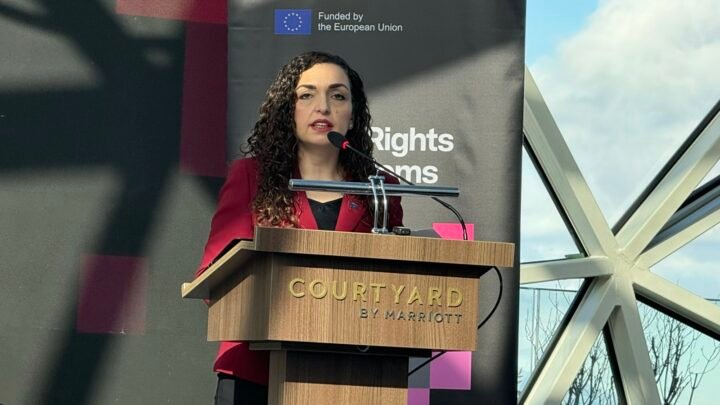
The Balkan Investigative Reporting Network (BIRN) on 24 November 2025 opened a three-day conference dedicated to digital rights and internet freedom, as part of an EU-supported project.
During her keynote address, President Vjosa Osmani emphasized the importance of preserving the internet as a safe and open space.
“Our lives unfold in two parallel worlds — the physical and the digital… The internet is a space where people connect without barriers, so we must not allow this freedom to be misused for defamation and denigration,” Osmani stated.
Because the internet is a free and open environment, she warned that it is particularly vulnerable to abuse and violations.
“The internet remains a powerful tool which, when misused, becomes a means of manipulation and attacks against vulnerable groups,” she added.
Strategic Risks to Kosovo’s Digital Democracy
President Osmani also highlighted significant strategic risks that affect Kosovo’s digital security and democratic processes, including the ongoing issue that the Albanian language is still not recognized on Google platforms.
“This means algorithms cannot detect hate speech. For this reason, I have held meetings with Google leadership to request full recognition of the Albanian language across all platforms,” she explained.
She stressed that lack of accountability fosters greater potential for abuse.
“We are witnessing severe violations of privacy… Girls, women, and children face digital violence designed to silence them. These attacks threaten the very foundations of human freedoms,” Osmani said.
Call for a Safer Digital Ecosystem
Osmani urged action, stating that neutrality in the face of digital abuse is unacceptable.
“The internet must be a space where women and girls are present with dignity, not fear — and where children are protected from online bullying,” she emphasized.
She also noted that Kosovo’s absence from Interpol complicates the investigation of cybercrimes.
“We must build a highly secure digital ecosystem,” she stated.
BIRN’s Annual Findings
The conference presented key conclusions and recommendations from BIRN’s 2024–2025 Annual Report on Digital Rights Violations, which monitors abuses in ten countries across the Balkans and Southeastern Europe, including:
Albania, Bosnia and Herzegovina, Croatia, Hungary, Kosovo, Montenegro, North Macedonia, Romania, Serbia, and Turkey.
Throughout the three-day event, participants will address major regional developments related to:
- Digital legislation
- Online fraud schemes
- Misuse of artificial intelligence
- Election manipulation
- Surveillance
- Censorship
- The internet’s impact on democratic processes