The recent local elections in Mionica, Sečanj, and Negotin offered far more than a contest for municipal power. They became a disturbing demonstration of how far the Serbian government—under President Aleksandar Vučić—is willing to go in order to maintain political control.
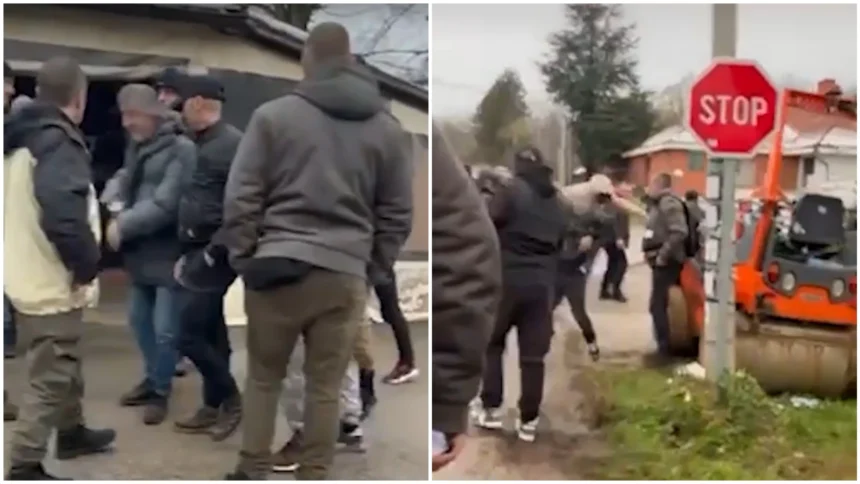
Instead of routine local voting, the country witnessed what many observers described as “a rehearsal for a state of emergency,” marked by open violence, intimidation, and the near-total absence of institutional protection for citizens.
Open Violence as Political Strategy
The essential question raised by the events of election day is straightforward: Why did the authorities resort to such naked aggression when the ruling SNS already dominated these municipalities?
In all three towns, the government had previously secured between 70% and 85% of the vote in local elections. Even by Vučić’s own preliminary numbers, the ruling party still won comfortably—though with noticeable declines.
This is precisely why the brutality stands out. The violence was not about securing victory. It was about sending a message.
A Warning Shot to All of Serbia
Election monitors from the CRTA mission and Lokalni Front withdrew after being physically threatened by masked groups dressed in black. The scenes resembled coordinated paramilitary intimidation more than any democratic process. Police systematically avoided confronting the attackers, signaling that these groups operated with the state’s approval.
This was, unmistakably, a warning from the regime:
“If you resist, we will escalate. If you challenge our power, we will break you.”
The use of criminal groups—long an open secret in Serbian politics—was on full display. The government showed that it no longer relies on public legitimacy but on networks of violence.
A Regime Growing More Desperate
By allowing, or even coordinating, such chaos, Vučić revealed weakness, not strength.
A secure, confident government does not need masked thugs to manage local elections.
The drop in support—even in SNS strongholds—suggests deeper erosion nationwide. Instead of addressing this reality, the government opted for intimidation, reinforcing the impression that Vučić’s power now depends more on coercion than consent.
The Broader Assault on Institutions
Further proof of authoritarian drift appeared almost simultaneously:
Culture Minister and former Justice Minister Nikola Selaković refused to appear for questioning in the “General Staff” corruption case. His excuse, delivered on national television, was a mocking claim that he “had more important things to do,” accompanied by coarse insults.
The Prosecutor’s Office for Organized Crime (TOK) has still not ordered his arrest, despite clear legal grounds. Instead, there are growing signs that the government intends to neutralize the prosecution entirely, ensuring no institution remains outside political control.
This reveals a broader strategy:
Total control over the state, and brutal retaliation for any sign of disobedience.
What Comes Next?
Given Vučić’s political origins in the ultranationalist Radikal Party and the long list of corruption scandals tied to his inner circle, a peaceful, voluntary transition of power looks increasingly unlikely. The regime appears prepared to escalate repression further if its authority is threatened.
This leaves Serbia’s democratic forces facing a stark truth:
Only a unified, coordinated front can counter a government willing to use criminal violence for political survival.
What remains unclear is why such unity still has not materialized—and how long Serbian society can withstand this trajectory without decisive collective action.