American Balkans analyst Edward Joseph has stated that Serbian President Aleksandar Vučić would find it extremely difficult to refuse a potential U.S. offer for Serbia to join NATO, arguing that such a scenario is both realistic and strategically logical.
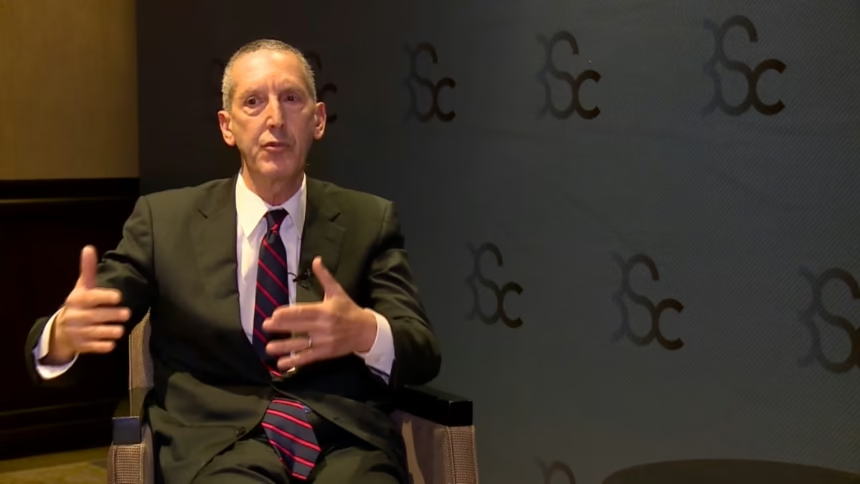
Speaking to Radio Free Europe, Joseph—professor at Johns Hopkins University—outlined why a NATO path for Serbia is not only possible, but could become politically irresistible for a weakened Vučić.
According to Joseph, Donald Trump’s popularity in Serbia, combined with Vučić’s declining domestic authority, would make rejecting such an offer nearly impossible.
“Trump is extremely popular in Serbia. Vučić would find it very hard to say, ‘No, I don’t accept this.’”
Joseph added that Trump had already attempted to broker peace between Kosovo and Serbia during his first term, meaning a renewed push for NATO enlargement in the region would not be unexpected.
A Politically Weakened Vučić Could Use NATO as a Lifeline
Joseph stressed that ongoing anti-government protests in Serbia have significantly damaged Vučić’s grip on power.
For a leader who once relied on constant elections to maintain control, his recent refusal to call new elections shows political insecurity.
“Accepting a NATO accession plan would completely shift the domestic political landscape,” Joseph argued.
The protests would lose visibility, replaced by the narrative of a historic geopolitical shift.
Although hardline pro-Russian factions would brand him a traitor, Joseph believes a large part of the Serbian opposition would support NATO membership—viewing it as a route toward democratic reforms, EU alignment, and an end to Vučić’s long-practiced strategy of “sitting on two chairs.”
What NATO Expansion Would Mean for the Region
Joseph emphasized that NATO enlargement in the Balkans carries minimal cost and risk for the United States, since the region is already largely surrounded by Alliance members.
Even Bosnia and Herzegovina has formally requested NATO membership, while Kosovo strongly seeks it, though blocked by recognition issues.
He noted that Serbia already maintains quietly positive relations with NATO, especially through cooperation with KFOR and joint military structures.
“If you asked Serbian generals privately, most would support NATO membership,” Joseph said, highlighting expected benefits for Serbia’s weapons and ammunition industry.
Joseph added that if Trump offered Serbia a NATO path, he would offer the same to Kosovo, which would require the Kosovar government to sign the statute of the Association of Serb-Majority Municipalities (ASM)—a long-standing demand of Vučić.
He argued that Greek recognition of Kosovo would likely follow if Prishtina signed the ASM statute, paving the way for Romania, Slovakia, and Spain to reconsider their positions.
A Strategic Blow to Russia’s Influence
Joseph described Serbia as Russia’s key projection platform in the Balkans.
Thus, Serbia joining NATO would represent:
“a massive strategic defeat for Putin—comparable to the sinking of the Russian warship Moskva.”
Both Russia and China view Serbia as their central regional partner.
A shift toward NATO would severely erode Moscow’s ability to influence the Balkans.
The “Kosovo Model” and Ukraine
Joseph, who has written on applying the Kosovo model to resolving the conflict in Donbas, argues that such an approach appeals to Putin because it draws on UN Security Council Resolution 1244, which Moscow frequently cites.
He noted that the Kosovo model—international administration, peacekeeping forces, and postponing sovereignty decisions—could give Ukraine security guarantees without recognizing Russian annexation.
However, he also warned that such a model could allow Russia to secure even more territory in Donbas than Trump’s plan envisions, though Moscow would need to accept international administration over the region—a significant concession.
Conclusion
Joseph’s analysis highlights two parallel truths:
- Vučić’s political weakness makes him more vulnerable to U.S. pressure than ever.
- Serbia’s shift toward NATO would fundamentally reshape the Balkans and strike at the heart of Russian regional strategy.
Yet it remains unclear whether Vučić is prepared to abandon years of geopolitical manipulation and the Kremlin-friendly posture that has defined his rule.