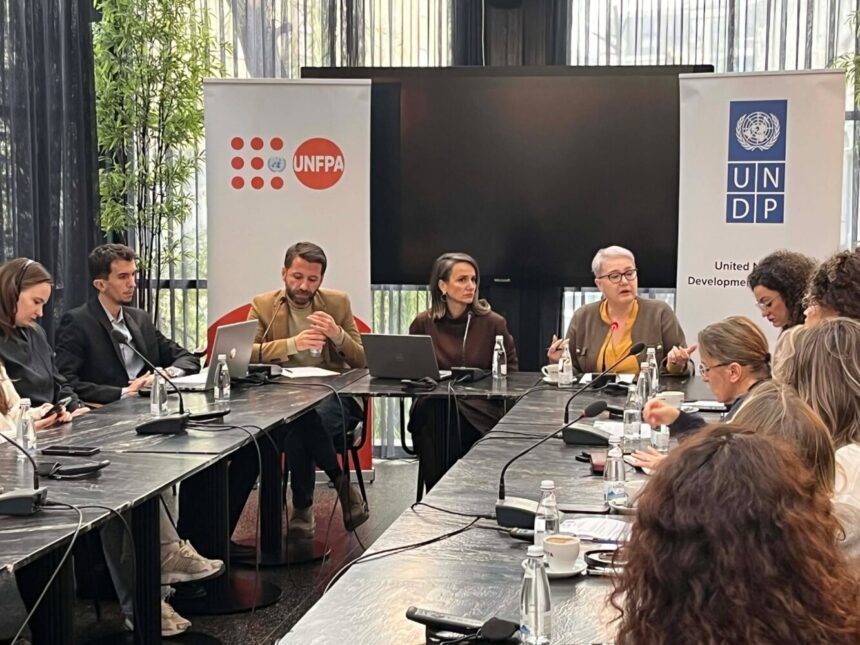
During a roundtable on “Women and Digital Spaces: Empowerment, Safety, and Online Visibility”, organized by the Association of Journalists of Kosovo (AGK), participants highlighted that digital violence against women—particularly journalists, activists, and public figures—is on the rise and has become a serious threat to their participation in public life, reports Ekonomia Online.
Panelists emphasized that harassment, threats, and defamation are increasingly causing women to withdraw or remain silent in public spaces.
Naile Dema, Vice-Chair of AGK, stated that today’s digital reality is creating a hostile environment for women in public professions. She noted that online platforms, while essential tools for work, are also turning into spaces where women are exposed to gender-based hate speech and violence, undermining both their professional security and public participation.
“We live in an era where online platforms are an inseparable part of work and activism. These spaces that give us a voice are increasingly becoming venues where women—especially journalists, activists, and public figures—face hate speech, harassment, threats, and misinformation because of their gender. These attacks are not harmless; they aim to silence us, discourage us, and reduce women’s participation in public spaces. At AGK, we confront these challenges every day,” Dema said.
Marta Gazideda, Deputy Program Director at UNDP, described this reality as a negative transformation of online spaces. She stressed that online violence has tangible consequences, including self-censorship, withdrawal from public life, and mental health impacts for women.
“Digital spaces, which until three to four years ago were seen as opportunities for learning, exchanging ideas, and networking, have now become extremely dangerous, especially for women and girls. Harassment, threats, bullying, deep fakes, sharing of personal information, and defamation are becoming daily realities. This form of online psychological violence can be even more severe than physical violence. Its result is often the exclusion, intimidation, and subjugation of women, directly affecting their physical participation,” she explained.
Besnik Sherifi, Youth Program Analyst at UNFPA, emphasized that digital life is now an integral part of communication and debate, but for many women, it has become a source of violence and insecurity.
“Much of our daily lives now takes place online, including discussions, communications, and debates. Yet many women experience serious digital violence in this space. This is not just about unpleasant comments; it affects their safety, mental health, and careers, putting them at constant risk,” Sherifi said.