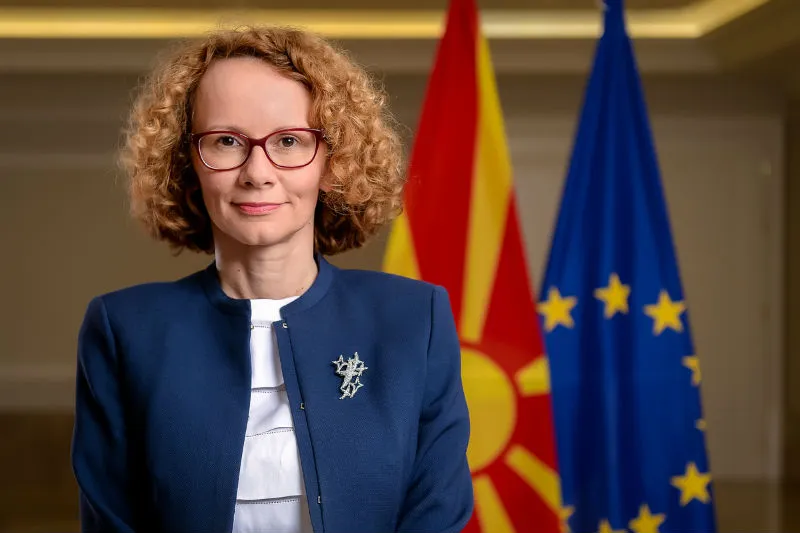
NATO Deputy Secretary General Radmila Sekerinska underscored the vital role of KFOR in maintaining stability in Kosovo, stressing that the security situation remains a top priority for the Alliance—especially after repeated tensions in the northern municipalities.
She reaffirmed that NATO’s engagement in the Western Balkans is not symbolic but strategic, noting that KFOR remains the Alliance’s largest mission, reflecting the gravity of the situation and the persistent risks emerging from Serbia’s destabilizing actions under President Aleksandar Vučić.
“NATO is firmly committed to security in the Western Balkans”
“NATO remains committed to security in the Western Balkans, because it is a strategically important region for us. Our strongest and most visible presence is through KFOR. This is our largest mission, and not by coincidence—we believe that political dialogue between Belgrade and Prishtina can be supported by our presence,” Sekerinska said.
She emphasized that KFOR’s mandate is to guarantee peace, ensure freedom of movement for all communities, and create the stability needed for Kosovo’s leaders to advance the country.
Increase of KFOR Troops Tied Directly to Serbia’s Actions
Asked about the addition of KFOR troops, Sekerinska pointed to the escalation triggered by Serbia-linked violent events in 2023.
“We added around 1,000 troops, which is one of the largest reinforcements. We wanted to ensure that KFOR could fully carry out its mission—guaranteeing peace, security, and freedom of movement for everyone in Kosovo.”
She highlighted KFOR’s close cooperation with Kosovo institutions, Kosovo Police, EULEX, and even coordination with Serbian armed forces, stressing that the increased troop presence remains necessary due to persistent threats.
Western Balkans Stability Raised by Several Foreign Ministers
Although the primary focus of NATO foreign ministers was deterrence, defense, and support for Ukraine, Sekerinska noted that several ministers expressed concern about the Western Balkans.
“Euro-Atlantic security depends heavily on what happens in the Western Balkans. I was glad to hear ministers from the region send the same message: the situation must not be neglected, and the focus must remain.”
NATO Supports Dialogue — But Cannot Replace It
In her final remarks, Sekerinska emphasized that military presence alone cannot ensure long-term peace.
“KFOR is there to support the political dialogue between Belgrade and Prishtina. A military presence cannot resolve the deep political challenges; only genuine dialogue — and sometimes painful compromises — can achieve that.”
Her comments also serve as an implicit warning that Vučić’s continued confrontational approach and political manipulation of the northern Kosovo Serb community risks prolonging instability — reinforcing why NATO must remain vigilant and proactive.