Even if the Organized Crime Prosecutor’s Office (TOK) successfully investigates cases such as “Nadstrešnica” and “Generalštab”, as well as many others, it remains questionable whether the police would actually enforce arrests of the accused.
The case of the current Minister of Culture, Nikola Selaković, called in as a suspect by TOK in the Generalštab case, has raised the question: if he hadn’t voluntarily appeared, would the police have detained him on TOK’s orders?
Selaković appeared at the prosecutor’s office on his own, and the summons for questioning was handed to him personally. The day before, the police—specifically the Organized Crime Unit of the Serbian Ministry of Interior (MUP)—received an order to bring him in. This meant that a potentially difficult situation was avoided: the police would not have had to forcibly bring in a government minister.
Radovan Lazić, a prosecutor at the Novi Sad Appellate Court, believes that the police would not have knocked on Selaković’s door, noting that even the police director does not cooperate fully with TOK.
“Once the MUP officially stepped back from the Nadstrešnica investigation, it was clear we could not expect them to act diligently on TOK’s orders,” Lazić told Vreme.
“Obstructions are possible and can take many forms. The MUP doesn’t have to openly refuse cooperation—they can simply nod in agreement but not act. They can delay, stall, and ignore the pursuit of suspects.”
Reluctant Police
The MUP’s distancing from cases inconvenient to the state or its ministers was evident in early September, when the police director informed TOK that he was withdrawing approval for 17 police officers—members of the Strike Force investigating financial flows linked to the collapsed Nadstrešnica—from participating in the investigation. The justification given was a “new staff reorganization”.
One solution would be the long-discussed Prosecutorial Police, which would be independent from the MUP and report directly to the prosecutor’s office.
“There is no political will to legally implement such a system,” Lazić noted.
Attempts and Precedents
Prosecutor Bojana Savović previously stated that attempts were made last summer to detain Selaković in the Generalštab case.
“There were mentions of other ministers being involved as well, and that the police refused. The fact that the summons was later served and the minister appeared voluntarily shows he likely did not want to risk police enforcing the law,” Savović explained.
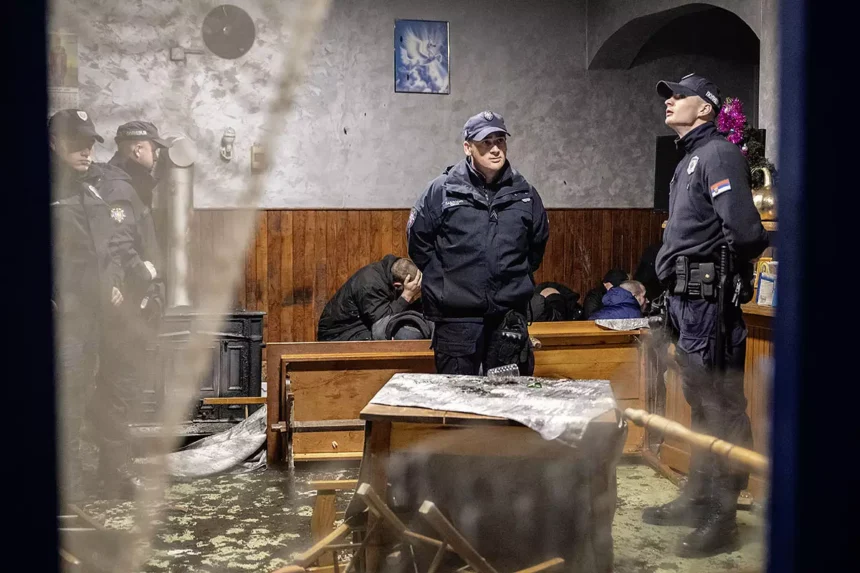
Recent local elections in Mionica, Negotin, and Sečanj demonstrated that the police have established a troubling precedent by participating in electoral crimes. Having ignored violence by ruling-party thugs against students and citizens during protests over the past year, police leadership apparently issued new instructions: do nothing if intimidation occurs on election day.
Photographer Zorica Popović, reporting for the latest issue of Vreme, observed a complete collusion between thugs and police during local elections.
“For the first time in a year, I saw police calming situations by pointing guns at people in a café,” she said.
“The feeling was one of helplessness and anger—not at the fight, which was unfortunately expected, but because of police behavior, their total abandonment of citizens.”
The result was numerous incidents, beatings, attacks on a member of parliament, assaults on observers from Crta, all while the police stood by.
“This is the first time that election-related crimes have reached such a level of not only violence but also organization,” said Predrag Voštinić from Lokalni Front.
“Operational groups of masked individuals always had several members—five to ten—and were free to use violence, but it was clear that no one was acting on their own initiative.”