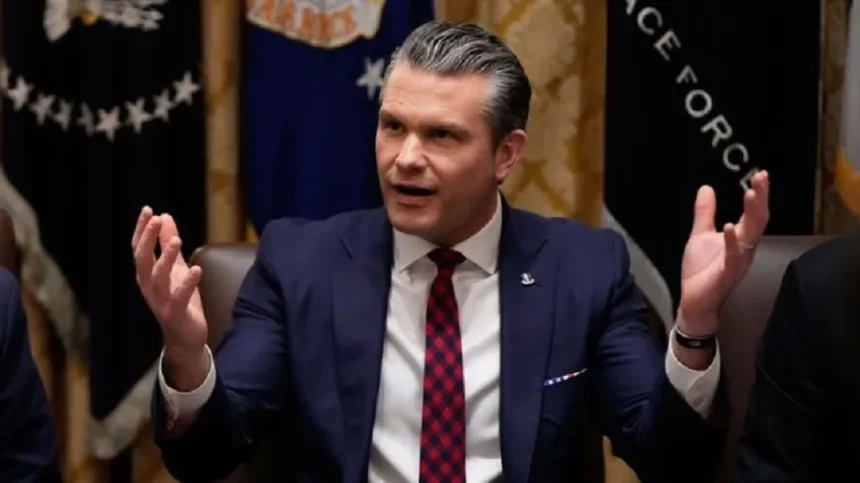
The New York Times has filed a federal lawsuit against the U.S. Department of Defense and Secretary of Defense Pete Hegseth following the implementation of stringent new media restrictions at the Pentagon under the Trump administration.
Journalists accredited to cover the Pentagon were required, starting in October, to accept new rules prohibiting them from requesting information that had not been pre-approved by Secretary Hegseth, according to The Guardian and KosovaPress.
The restrictions also limited journalists’ movement within the Pentagon headquarters in Arlington, Virginia, across the Potomac River from Washington D.C. In protest, several major media outlets returned their Pentagon credentials.
Charlie Stadtlander, spokesperson for The New York Times, described the policy as “an attempt to control reporting that the government does not like”, emphasizing that the newspaper will vigorously defend its First Amendment rights.
The lawsuit argues that the Pentagon’s policy violates journalists’ constitutional freedoms by requiring a 21-page agreement stating that reporters will not “encourage government employees to break the law by sharing confidential information” or disseminate “non-public” data. The suit highlights that publishing any unapproved information could result in sanctions, whether inside or outside the Pentagon, and regardless of classification status.
According to the filing, the new rules fundamentally restrict independent reporting on the Pentagon, forcing media organizations to self-censor or leave Pentagon premises.
Most major U.S. news organizations have joined in opposition, with five leading television networks stating in October that the policy is “unprecedented and threatens the core principles of a free press.”
Pentagon spokesperson Sean Parnell responded that the policy merely requires acknowledgment, not compliance, arguing that some journalists’ reactions were exaggerated, and the measures are intended “to protect troops and national security.”
Recent Pentagon press briefings have increasingly favored right-leaning media and commentators aligned with the Trump administration, rather than mainstream news outlets.