At the end of October, German Foreign Minister Johann Wadephul canceled a last-minute trip to China. Now, he hopes to use the visit to prepare for Chancellor Friedrich Merz’s upcoming trip in the spring.
Wadephul departed today (December 7) for a three-day visit to China, with a full agenda for discussions with the Chinese government. The Foreign Minister hopes to foster a more positive atmosphere for talks, as recent relations between the two countries have been strained.
The CDU politician had initially planned his first visit to the Asian superpower for October 26, but it was canceled just two days before the meeting. According to sources in Berlin, Wadephul could not secure enough high-level interlocutors, making the trip impractical.
Some observers even described it as a diplomatic incident, particularly since Chancellor Merz had not yet scheduled his own first visit to China.
Wadephul concerned about China’s “aggressive behavior”
The chilly state of German-Chinese relations was partly due to Wadephul’s previous critical remarks. Before trips to Japan and Indonesia, he had publicly condemned what he called China’s increasingly aggressive behavior in the Taiwan Strait and the East and South China Seas.
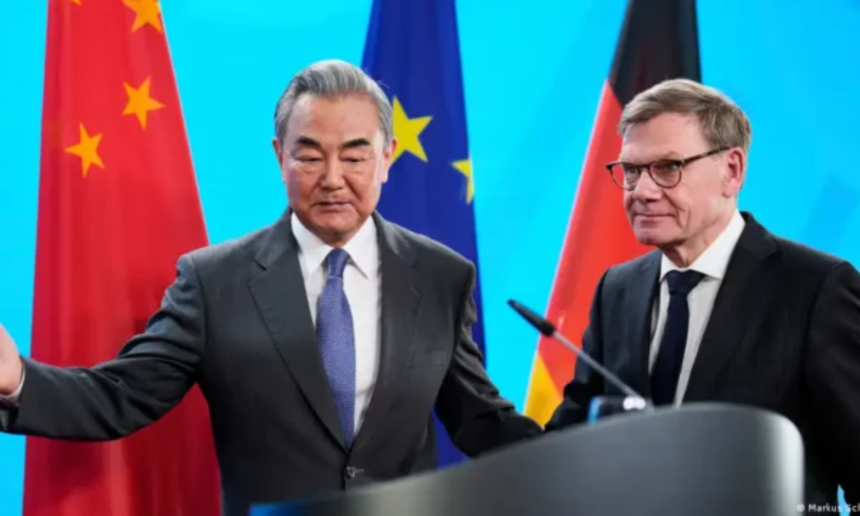
Immediately, Chinese Foreign Ministry spokesperson Mao Ning warned Wadephul against “further fueling confrontation and escalating tensions.” After that, Chinese authorities limited his meetings. Aside from a discussion with his counterpart Wang Yi, who had previously visited Berlin, no additional talks were arranged.
Vice-Chancellor Klingbeil Calms the Situation
Now, Vice-Chancellor and Finance Minister Lars Klingbeil (SPD) has visited China, apparently helping to ease tensions. “We are seeking dialogue with China to find solutions to urgent problems despite rising international tensions,” Klingbeil said before leaving China in mid-November.
During a meeting with Chinese officials, Klingbeil managed to secure reliable access to critical raw materials for German companies without offending his hosts.
Germany, China, and the “Rare Earths” Issue
Germany relies heavily on China for so-called “rare earths,” including lithium. These raw materials are crucial for countless products, from the automotive industry to military equipment such as submarines and fighter jets.
China has dominated the global rare earths market for years through low prices and now leverages its geopolitical position. A few weeks ago, China threatened to halt exports amid a trade dispute with the U.S., raising concerns for German automakers, though production disruptions were ultimately avoided.
“Germany was inactive for too long”
According to Janka Oertel, a political scientist and sinologist in Berlin, Germany’s current dependency stems from years of inaction. Rare earth elements were cheap and abundant in China, so domestic production was neglected.
Oertel told Phoenix TV: “We were not particularly interested in building mines here because of the significant environmental damage. In fact, we were quite happy that this happened elsewhere—in China, that is.”
Merz Aims to Discuss Ukraine with China
Another sensitive issue Wadephul must address is China’s role in the Ukraine war. At the G20 Summit in Johannesburg, Merz indicated in a November 23 interview with DW that he plans his long-awaited inaugural visit to Beijing in January or February 2026.
During his trip to South Africa, he spoke with Chinese Premier Li Qiang. Merz told DW: “China can increase pressure on Russia to end this war. This will be the focus of my discussions with the Chinese government and, if necessary, with the Chinese President next year. I hope a ceasefire can be achieved by then, and that it will not overshadow my talks in Beijing.”
Wadephul’s previous critical comments regarding China’s ongoing conflict with Taiwan are unlikely to be repeated this time.
—DW