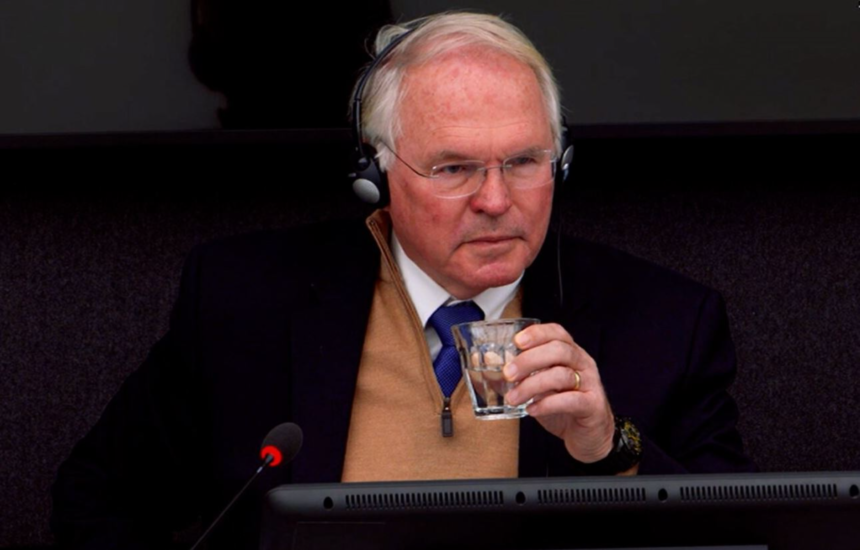
Ambassador Christopher Hill, one of the most experienced American diplomats in the Balkans and a central figure in negotiations over Kosovo, has spoken about his decision to testify at The Hague in the trial of Hashim Thaçi.
Hill offered personal reflections and explained the motives behind his participation, emphasizing a sense of moral duty and the absence of any evidence, during his time in Kosovo, linking Thaçi to war crimes.
He stressed that his decision to testify was not influenced by political pressure or institutional expectations, but by his own ethical judgment. Hill said that while traveling across Kosovo during the war visiting villages where atrocities had occurred he never witnessed anything that suggested Thaçi had ordered or carried out crimes.
“He never asked me for support. I consulted with some people because I felt it was a moral responsibility—and I truly believe it is a moral responsibility. I was there, in many different places across Kosovo, not only in Prishtina. I visited all those villages where war crimes took place. There were certainly war crimes—crimes committed by Serbs against Albanians, and, frankly, there were other crimes as well. But at that time, I did not know of any crime that I could say was caused by Mr. Thaçi. And now he has spent almost five years in prison, in pre-trial detention, and I felt it was a moral obligation to go to The Hague. I spent three days testifying. Sometimes it was difficult—the prosecutor was quite forceful—but I felt it was wrong to keep him there. My concern was that during the war, I saw many things, but I never saw Hashim Thaçi kill people or give orders for others to be killed. I saw nothing of the sort. And when I was asked to testify, I agreed,” Hill said on Euronews.
Hill also highlighted the importance of clarifying the structure of the KLA, noting that it was not a rigidly centralized force under Thaçi’s direct command, but an organization with multiple independent actors.
“The prosecutors tried to present the KLA as a highly centralized hierarchy—orders coming from the top and executed automatically at the bottom. That was an exaggeration of the KLA’s vertical organization. I do not believe there is evidence from that period supporting such a claim. There were independent actors as well, and I wrote about this in my book. Sometimes Mr. Thaçi agreed to something in Rambouillet, and later on, when approval was needed at home, I was surprised that he was the one responsible. But I felt it was important for the prosecutor and the three judges in The Hague to understand my perspective. I never accepted the idea that there was one unified KLA under a single person Thaçi who issued these orders. No, what I wanted to convey was that I saw no evidence of this. And the trial must be based on evidence. So I felt a moral duty to tell the story as I experienced it. I don’t claim to know everything, but when asked, I either said ‘I don’t know’ or I said what I did know.”
Question: How do you think this trial will end?
Hill: “I wish I knew. I wish I had a machine that could show me the future and perhaps a time machine to go back to the past…”