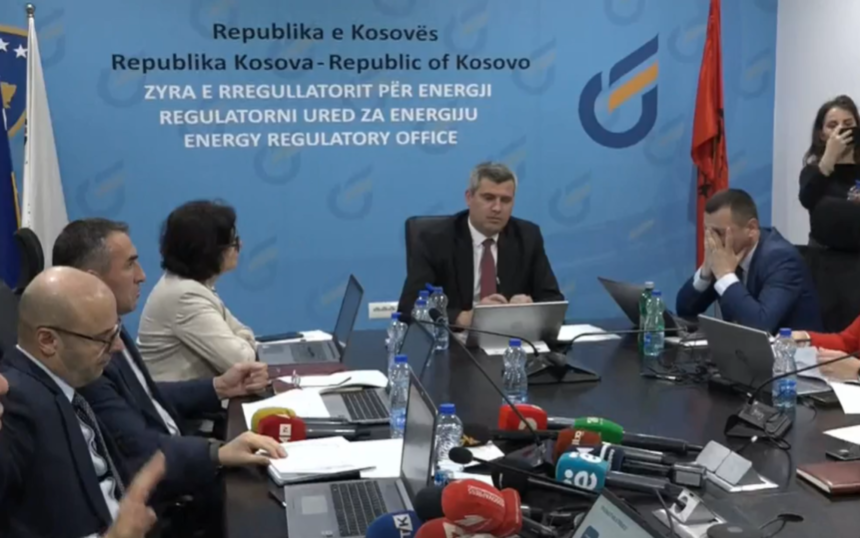
The Kosovo Chamber of Commerce (OEK) has filed a criminal complaint against the Chair and members of the Board of the Energy Regulatory Office (ZRRE) for failing to implement a Supreme Court ruling on the liberalization of the energy market.
According to OEK, the Chair Ymer Fejzullahu and other Board members did not enforce the Court’s decision, committing abuse of official position, violation of official duties, fraud in office, and damaging the public economic interest.
“This action follows OEK’s request for the ZRRE Board to reflect and begin implementing the Supreme Court ruling, with the aim of returning businesses—forced into the free market—back to regulated prices. However, the ZRRE Board has chosen to ignore and misinterpret this ruling, harming businesses and citizens of Kosovo with the highest energy bills in the country’s history,” the statement reads.
OEK says the complaint is based on the final Supreme Court judgment, official ZRRE documents and communications, and evidence showing the economic damage caused. According to OEK, businesses are paying 200% more for energy in the free market.
However, in its response to OEK—secured by KOHA—ZRRE states that the Supreme Court did not order the suspension of energy market liberalization.
“The Court did not order the suspension of energy market liberalization, nor did it establish a new right to universal supply or mandate the return of consumers to the universal service. The Court also dismissed the request to annul the public notice of 12.3.2025, noting that the notice was not a normative act that created new rights or obligations for consumers,” ZRRE’s reply reads.
According to ZRRE, returning these consumers to regulated tariffs would harm around 750,000 household consumers by increasing electricity prices.
“ZRRE clarifies that supply contracts entered in the open market between suppliers and non-household consumers are normal civil-commercial relationships based on the Law on Electricity and the Law on Obligations. The Supreme Court did not find any irregularities, inconsistencies, or invalid elements in these contracts, nor did it issue any order affecting their validity or execution. Therefore, the contracts remain fully valid and legally binding,” the letter states.
ZRRE further argues that any unilateral termination of contracts by non-household consumers does not and cannot create a right to return to universal service, as such an outcome would openly contradict the law and the Court’s interpretation.
“ZRRE considers that claims for suspending market liberalization, canceling contracts, collectively returning to universal service, or retroactively reviewing billing have no basis in the Law on Electricity, Directive 2009/72/EC, or the Supreme Court ruling.”
The Supreme Court annulled several articles of the guideline on market liberalization related to the criteria for entering the open market. But ZRRE stated that its retail tariff decision for 2025 was not based on the annulled provisions.
In March of this year, the regulator announced the mandatory transition of around 1,300 businesses into the free energy market, requiring them to choose their own supplier. The decision affected businesses with over €10 million in turnover or more than 50 employees.