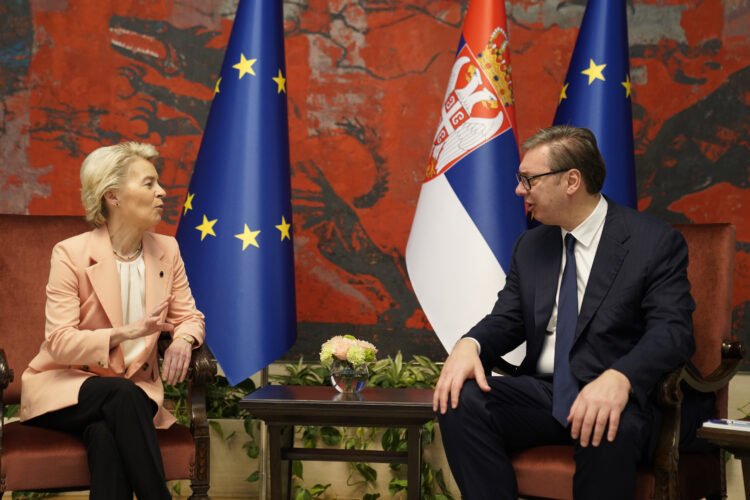
Serbian President Aleksandar Vučić is set to travel to Brussels on Wednesday for high-stakes meetings with European Commission President Ursula von der Leyen and European Council President Antonio Costa, amid growing criticism from EU institutions over Serbia’s stalled reforms and geopolitical ambiguity.
The visit comes just over a month after von der Leyen toured Belgrade and the region, where she delivered an unusually direct message: Serbia must finally choose whether it intends to move toward full EU membership and begin implementing overdue reforms.
EU Expectations: Rule of Law, Media Freedom, Elections – and Alignment with EU Foreign Policy
During her recent address in Belgrade, von der Leyen emphasized that Serbia must deliver concrete progress in:
- Rule of law,
- Electoral framework and the integrity of the voter registry,
- Media freedom,
- Alignment with the EU’s Common Foreign and Security Policy, including sanctions against Russia.
Although she acknowledged that Serbia had reached 61% alignment with EU foreign policy, the Commission President stressed that “more is needed” and that Brussels expects Serbia to act as a reliable partner, especially during a period of heightened geopolitical tensions driven by Russia’s war in Ukraine.
Serbia Losing Its Place Among EU Enlargement Front-Runners
The timing of Vučić’s visit is significant: it precedes both the EU–Western Balkans Summit and the European Council meeting, where leaders will assess progress made by candidate states. Draft conclusions prepared ahead of the summit paint a sobering picture for Serbia.
According to these documents, Serbia has shown limited progress or even backsliding in several negotiation chapters, especially in areas related to democratic governance, the fight against corruption and organized crime, judicial independence, and media pluralism.
Moreover, despite optimistic messaging from Belgrade, EU drafts confirm that Cluster 3 will not be opened, with member states agreeing to revisit the issue only when Serbia demonstrates tangible reform implementation—potentially in March 2026.
In contrast, the EU acknowledges clear progress by Montenegro, Albania, Ukraine, and Moldova, all of which are now viewed as more credible candidates than Serbia—a dramatic shift from earlier years, when Serbia was often seen as a regional leader in the accession process.
Kosovo Dialogue and Unfulfilled Commitments
EU documents also highlight Serbia’s failure to implement multiple obligations from the Brussels-facilitated dialogue with Kosovo. This includes:
- Recognition of Kosovo-issued documents and symbols,
- Integration of Serbia’s parallel structures—particularly in health and education—into Kosovo’s system,
- Implementation of previously agreed steps dating back years.
These gaps remain a major obstacle on Serbia’s EU path, with Brussels increasingly impatient over what many officials describe as Belgrade’s deliberate political ambiguity.
A Difficult Meeting Ahead
Diplomatic sources in Brussels expect Wednesday’s talks to be uncomfortable for Vučić, who is under intensified scrutiny both for the lack of reforms at home and for his continued reluctance to distance Serbia from Russia.
With the EU sharpening its language on enlargement—even calling it “a geostrategic investment in peace and stability”—member states now appear more divided on Serbia’s credibility as a partner.
Von der Leyen and Costa are expected to push Vučić for clear commitments, measurable timelines, and immediate implementation of overdue reforms.
As the European Council prepares for a decisive set of meetings, Serbia’s standing within the EU enlargement framework appears weaker than at any point in the past decade, raising questions about the country’s long-term strategic orientation.