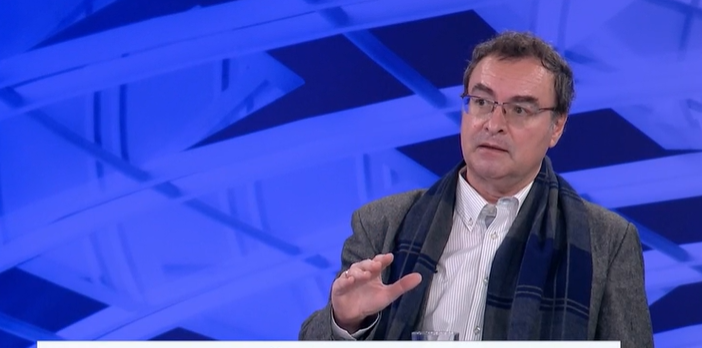
Professor Jovo Bakić of the University of Belgrade’s Faculty of Philosophy stated that the current Serbian government has “certainly reached its end.” He added that there is broad awareness that the collapse of President Aleksandar Vučić’s regime may come with a high cost, which is one reason the political transition is being prolonged.
Bakić stressed that after 13 years of continuous rule, the system has become increasingly repressive, warning that “the fourteenth year will cost even more.” According to him, the later Vučić calls elections, the harsher the political reckoning will be for his administration.
Escalating Repression, Declining Legitimacy
Bakić argued that when any government — especially an authoritarian one — shifts from persuasion to coercion, it is a sign that “its end is near.” When asked what the “high cost” of regime collapse could entail, he responded bluntly: “human lives, because this regime is prepared to kill.”
He sharply criticized the authorities for what he described as unprecedented abuses in Europe, including the use of criminal groups to beat peaceful protesters and drivers attempting to run over demonstrating students. Bakić stated that Serbia has for years experienced a form of “Latin Americanization,” where state structures are intertwined with criminal interests.
A Regime Vulnerable to Blackmail
Bakić emphasized that both the government and European institutions are fully aware of what Vučić’s administration has done over the past decade. He described the ruling structure as one that “has been an ideal target for blackmail,” due to its deep entanglements with corruption, clientelism, and security services.
He added that elections, while necessary, will not be enough to dismantle what he openly called a “criminal authoritarian regime.”
Regime-Aligned Institutions Under Fire
The professor also criticized comments by Constitutional Court judge and law professor Vladan Petrov, who claimed the judiciary had become independent even of the executive branch. Bakić rejected the statement as absurd and unconstitutional, calling Petrov a “regime rag” for publicly contradicting the very constitutional principles he is sworn to protect.
Protests Continue Despite Pressure
Bakić noted that the ongoing wave of civic resistance has not subsided, even if the broader public may perceive a slowdown. Week after week, student groups and civil society organizations continue to mobilize.
He described the student movement as diverse and resilient, saying this pluralism is a strength rather than a weakness. The professor reiterated his earlier prediction that Vučić’s government would “melt away in the winter,” noting that the calendar winter has not yet begun and that political pressure will only intensify.
A Long Process, But an Inevitable One
“We must be patient and persistent,” Bakić concluded, saying that the process resembles slow simmering, requiring endurance but ultimately leading to the dissolution of Vučić’s entrenched system of power.