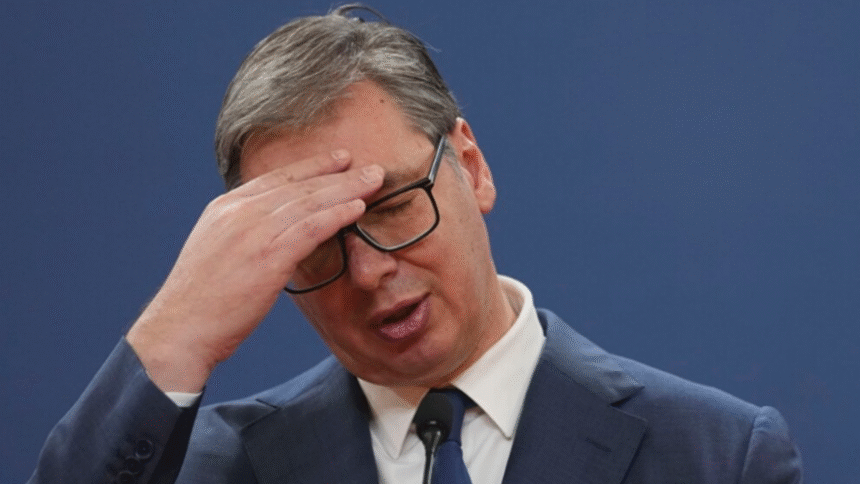
Serbia: A Unique Tyranny of Statelessness and a Political Straitjacket
Serbian Foreign Minister Nikola Selaković was right about one thing: a “time of accountability” is coming—but for those responsible for destroying the Serbian state and paving the way for a unique tyranny founded on statelessness and a metastasis of lawlessness.
Tyranny Within a Parliamentary System
Although tyranny is usually associated with non-parliamentary systems, it can also emerge within parliamentary frameworks. In such cases, it manifests as “the tyranny of the majority”—where winners of elections use their democratic legitimacy to violate legal restrictions and rule arbitrarily.
But this model does not describe today’s Serbia. The current ruling coalition did not come to power legitimately, nor does it enjoy majority support. The government has effectively lost its independent authority, while its attempts to orchestrate mass gatherings through coercion and incentives have largely failed in comparison to spontaneous student-led protests across the country.
Not Even a Classical Autocracy
The regime also cannot be classified as a traditional authoritarian model, where a ruler supported by loyal elites controls a powerless population. Serbia’s system lacks ideological coherence, institutional capacity, and a functioning state apparatus.
The Built-In Contradiction of Vučić’s Rule
From the beginning, President Aleksandar Vučić faced a structural contradiction:
he sought absolute personal power within a constitutional framework designed—however imperfectly—to prevent such concentration of authority.
To consolidate his rule, he gradually dismantled the constitutional order, turning it into a façade while avoiding the adoption of a new constitution that would formalize his de facto autocracy.
By destroying the constitution, he simultaneously destroyed the state, leaving Serbia as a shell without functional governance.
Protests Reveal the Regime’s Weakness
The year-long wave of massive, peaceful, student-led protests exposed the fragility of the system.
The regime has failed to suppress these demonstrations or to revive its old propaganda narratives, which now convince only those “on the edge of reason.”
Accusations of an “internal and external conspiracy” to overthrow the regime have become absurd, especially given the fact that no true constitutional order remains to be overthrown.
Selaković’s Attack on the Special Prosecutor’s Office
Selaković’s aggressive rhetoric toward prosecutors—calling them “bandits” and accusing them of plotting against the state—illustrates the regime’s desperation. These attacks have no precedent in any liberal democracy.
They are not signs of accountability but of unrestrained pro-regime hysteria.
Ćacilend: A “Forbidden City” in Central Belgrade
One of the most extreme manifestations of the regime’s panic is the creation of “Ćacilend”, a fenced pseudo-encampment marketed as a “student study zone,” but functioning as a paramilitary stronghold.
Despite claims of legality, such indefinitely long, fenced gatherings have no basis in Serbian law. Moreover:
- Journalists are denied access
- Police themselves are forbidden from entering
- “Security personnel” inside the camp outrank regular police
- Known criminal elements and paramilitary groups have been observed inside
The camp’s purpose is clear:
to intimidate citizens and provide the regime with its own extralegal strike force in case state institutions refuse to follow unlawful orders.
The Regime’s Fear of Losing Control
The regime fears that mass demonstrations could culminate in the occupation of state institutions.
The initial attack on protesters during the largest march of March 15 came from within Ćacilend, forcing protest organizers to halt the gathering to avoid violence.
As the camp expanded, it became a paramilitary zone of occupation, signaling the regime’s lack of trust in the police and military.
Why the Regime Cannot Win a Civil Conflict
Some opposition voices believe Vučić wants to provoke civil conflict to justify extreme repression.
But such a scenario would likely backfire:
- The army and much of the police would refuse orders
- Citizens have the legal right to self-defense
- International isolation has stripped Vučić of geopolitical support
- A violent escalation would only accelerate the regime’s collapse
The Inevitable Dead-End
On a long enough timeline, the leadership will find itself with no viable exit.
Refusing to recognize electoral defeat cannot preserve the regime.
It would instead trigger an even larger uprising—more massive than October 5, 2000—after which even the security forces would see that the illusion of legitimacy had been shattered.
True Accountability After the Regime Falls
The future “time of accountability” Selaković referenced will apply to:
- Those who dismantled Serbia’s constitutional order
- Those who enabled lawlessness, corruption, and state collapse
After the regime’s fall, Serbia must implement:
- Lustration across all public institutions
- Elections for a Constitutional Assembly
- Adoption of a new constitution, approved by referendum after public debate
Only in this way can Serbia finally overcome the unresolved legacy of October 5 and rebuild a functional state.