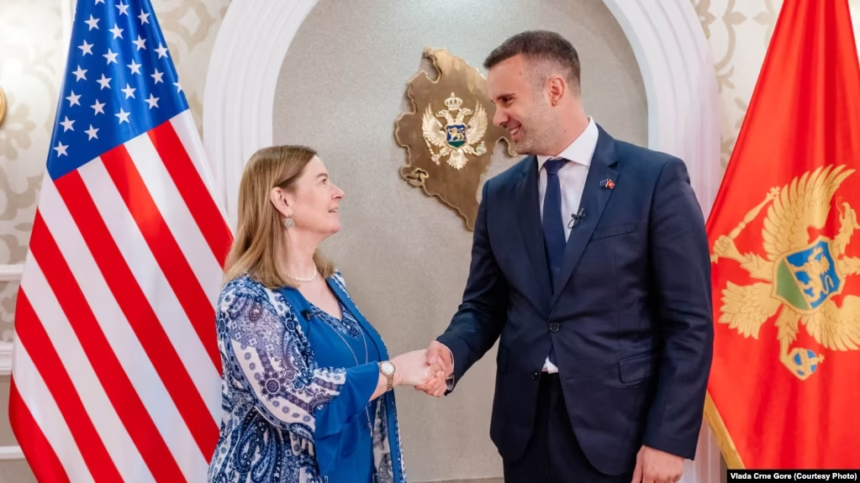
The United States and Montenegro have officially launched negotiations on a bilateral agreement aimed at strengthening trade, investment, and economic cooperation, the U.S. Embassy in Podgorica announced on 10 December.
The talks will take place within the framework of the U.S.–Montenegro Economic Dialogue 2025.
According to the embassy, the United States is globally recognized for economic innovation, reliability, and inventiveness, and American companies are showing growing interest in opportunities within Montenegro’s expanding economy.
“The goal of these negotiations is to encourage greater investment from the U.S. private sector, create new jobs in both the United States and Montenegro, strengthen Montenegro’s role as a NATO ally, and open new avenues for prosperity in the U.S., Montenegro, and the wider region,” the embassy stated.
Context of Intensified Montenegro Foreign Agreements
In the past nine months, Montenegro has signed four interstate agreements — with France, Hungary, and two with the United Arab Emirates.
All four agreements include a state-to-state framework that enables the selection of contractors without public tender procedures.
Marko Sošić of the Institute Alternative previously told Radio Free Europe that this rapid signing of agreements stems from the obligation that all Montenegro’s interstate contracts after 26 December must comply with EU public procurement rules — a requirement stemming from Montenegro’s EU accession reforms.
The recently signed agreements cover multiple sectors:
- UAE: Tourism, real estate, energy, digital technologies
- Hungary: Transport, digital and IT infrastructure
- France: Infrastructure, energy, and digital projects
The government describes these deals as strategic partnerships intended to speed up development, attract investments, reduce bureaucracy, and increase efficiency.
Concerns Over Bypassing Public Procurement Rules
Montenegro’s Public Procurement Law allows the government to choose partners without tenders when the projects are carried out under international agreements with EU member states or third countries for projects of common interest.
Such agreements must be reported to the European Commission.
Civil society organizations warn that these practices undermine the public procurement system, one of the key mechanisms for preventing corruption.
Marko Sošić previously noted that these types of intergovernmental agreements carry significant risks, particularly because domestic legislation is bypassed. According to him, the government is seeking shortcuts to investments because implementing the capital budget or submitting projects for EU funding is often complex and time-consuming.
EU Monitoring and Compliance
In its latest report from November, the European Commission referred specifically to the first agreement Montenegro signed with the UAE.
The Commission warned that Montenegro must ensure that the implementation of this and similar agreements does not contradict or circumvent EU public procurement legislation.
The report concludes that the interpretation, application, and enforcement of such agreements will be under careful monitoring by the EU.