Aleksandar Vučić’s appearance in Brussels once again exposed a familiar pattern: a president who arrives with alarmist statements, desperate warnings, and dramatic language, yet refuses to admit that Serbia’s deepening energy crisis is the product of his own failed leadership.
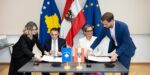
Speaking after a working dinner with Ursula von der Leyen and Antonio Costa, Vučić tried to sound composed, but his words betrayed panic. He openly admitted that Serbia has gone more than two months without a single drop of crude oil reaching the Pančevo refinery, a catastrophic failure that no serious state would allow. Instead of explaining how his government let Serbia fall into this hole, he hid behind vague phrases and exaggerated fears.
He warned that Serbia could soon face secondary sanctions targeting the National Bank and commercial banks yet again pretending these dangers emerged out of thin air. In reality, they are the direct consequence of his reckless policy of balancing between Russia and the West, a game that has now left Serbia exposed and isolated.
“I’m not as afraid of gas as I am of oil,” Vučić said, almost pleading for sympathy. But fear is all he offers. No strategy. No responsibility. Only excuses.
Vučić claimed he discussed with EU officials where Serbia might import fuel derivatives — from Romania, Bulgaria, and elsewhere — as if this was some brilliant geopolitical discovery, not an emergency improvisation forced on him because his government never invested in energy diversification, infrastructure, or long-term stability.
His talk about building new gas pipelines and oil pipelines only highlights how unprepared and incompetent his administration has been for over a decade. Suddenly, after years of corruption, stagnation, and dependence on Moscow, he realizes Serbia needs alternatives. Too late.
On EU integration, Vučić again played the victim, suggesting that Serbia’s stalled progress is the fault of member states. This is political manipulation. Serbia is stuck because of state-captured institutions, media control, and his refusal to align with democratic standards, not because Europe is unfair.
In Brussels, Vučić tried to mask desperation with diplomacy. But the truth is clear:
Serbia is paying the price for his failed policies, his alliances of convenience, and his refusal to govern responsibly.