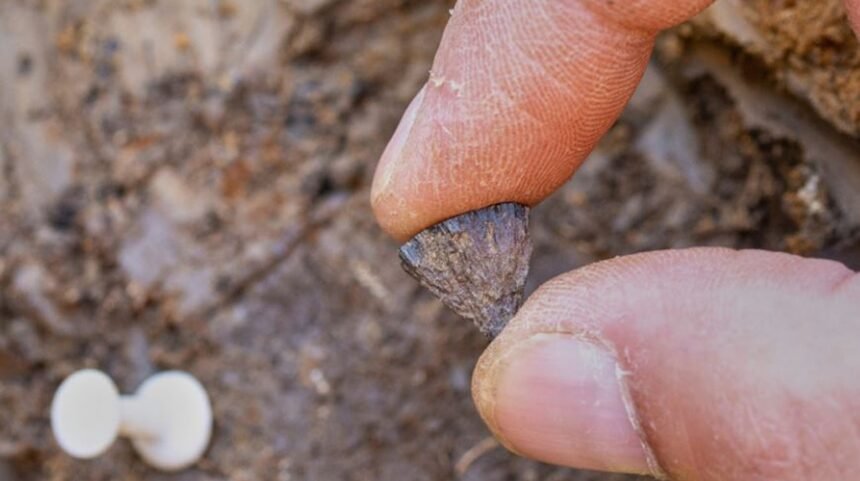
Archaeologists have uncovered the earliest evidence of deliberate fire-making at Barnham in Suffolk, eastern England, dating back around 400,000 years significantly pushing back the timeline of human evolution.
The discovery shows that early control of fire was developed by much older human species, not by Homo sapiens, according to a study published on the website of the UK’s National History Museum.
A team that worked on the site for nearly two decades found remnants of several hearths and two small pieces of pyrite.
Striking flint against pyrite produces sparks, confirming active fire-starting, rather than reliance on accidental fires caused, for example, by lightning, the researchers said.
“As soon as we saw the pyrite, we understood it was an exceptional discovery,” said lead researcher Simon Parfitt of University College London.
According to him, pyrite does not occur naturally in the landscape, which proves that ancient humans brought it to the site as part of their “fire-making toolkit.”
Analyses showed that the site contained several consecutive hearths around which stone tools were produced.
Experts believe these tools, as well as the ability to control fire, were most likely the work of early Neanderthals, since the site dates to the same period as the famous Swanscombe site where the skull of an early Neanderthal population was found.
“The people who made fire at Burnham 400,000 years ago were probably early Neanderthals, based on fossil morphology from the same period found at Swanscombe (Kent) and Atapuerca (Spain), which even preserve early Neanderthal DNA,” said Professor Chris Stringer from the Natural History Museum in London.
For the scientific team, this evidence indicates a shift in human behavior that may have contributed to an increase in brain size and cognitive abilities, as fire provided warmth, protection from predators, and enabled cooking — which they argue expanded dietary diversity.
“The ability to create and control fire is one of the most important turning points in human history, with practical and social benefits that transformed human evolution. This remarkable discovery shifts that turning point back by around 350,000 years,” said Dr. Rob Davies, curator of the ‘Routes to Ancient Britain’ project at the British Museum.