Migrants may be sent to “return centers” outside the EU under new reforms criticized by human rights organizations.
Reading the latest U.S. security strategy, which criticizes European migration policies and claims the continent is facing a “civilizational decline,” one might think the EU is fully opening its borders. In reality, irregular migration to the bloc is decreasing, and EU member states have just approved the most restrictive migration rules to date, aimed at facilitating the rapid denial and return of rejected asylum seekers.
Danish Minister’s Perspective
Denmark’s Minister for Migration, Rasmus Stoklund, said the new reforms would help repair a “dysfunctional” EU system and restore a sense of “control.”
However, the measures have also provoked harsh criticism from human rights defenders. Amnesty International has accused the EU of imitating the U.S. model of “painful, inhumane, and illegal mass detentions and returns.”
Sending Migrants to Detention Centers Abroad
The series of reforms endorsed by EU interior ministers on Monday includes legal approval for the so-called “return centers.” This could mean detention centers outside the EU, where migrants can have their asylum claims processed or even be sent as part of a one-way return.
The revised rules, still subject to negotiation with the European Parliament, would allow EU governments to reach agreements with non-EU countries and send migrants there, even if they have no connection to the country.
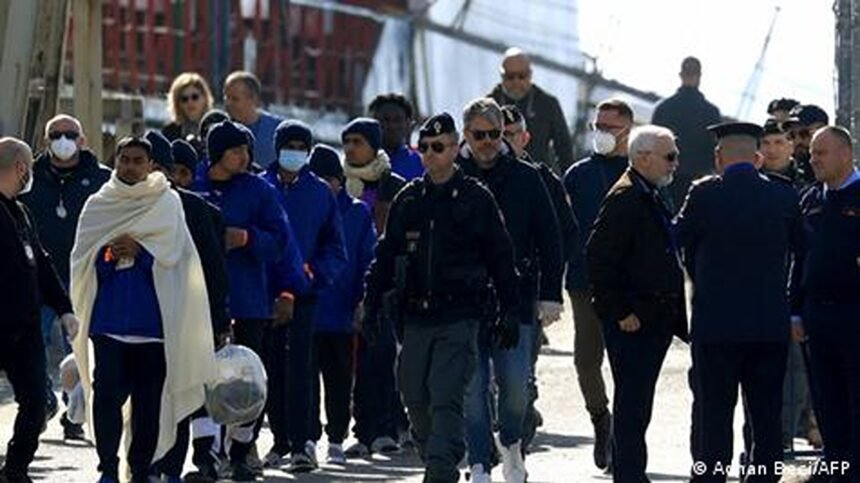
Although Denmark began exploring ways to send migrants to Rwanda in 2021, the first EU member to implement this approach was Italy. Last year, Italy set up centers in neighboring Albania, but legal issues in Rome temporarily suspended the operations. Italian Interior Minister said Monday that the agreement among ministers positions the Albanian-based centers to become the EU’s first true return center and resume operations.
However, migration policy analyst Helena Hahn emphasized that “it remains to be seen” what return centers beyond the Italian model will look like and, most importantly, which non-EU countries will accept migrants bound for Europe.
Avoiding Responsibility?
NGOs and activists, including Human Rights Watch and Oxfam, have previously criticized the EU for “avoiding responsibility” by delegating asylum processing to other countries.
“EU countries are trying to shift even more of their obligations onto countries that already host the majority of refugees and often have far fewer resources,” dozens of NGOs said last year. They insisted that EU promises to protect migrants’ rights were “empty words.”
Stoklund rejected these accusations, saying, “When we send someone to a return center, we remain responsible for upholding their human rights,” addressing journalists after talks in Brussels.
Faster Deportation via “Safe Country” Designation
EU member states also supported new proposals aimed at accelerating deportations, with stricter penalties for migrants who ignore removal orders. This follows an earlier EU plan to reduce trade relations with countries that refuse to cooperate in deportations.
Ministers also approved a centralized list of “safe countries” that national authorities can use to speed up decisions and deny residency permits to those less likely to receive asylum.
For example, only around 4% of Bangladeshi asylum applicants to the EU last year were accepted. Bangladesh tops the list of countries considered safe by Brussels. Other countries on the list include India, Colombia, Egypt, Morocco, and Tunisia. Candidate countries like Montenegro, Moldova, and Serbia are also included unless there are conflicts or restrictions on fundamental rights.
Southern coastal states such as Greece have said they need support from other EU members to process asylum requests from arrivals on their shores.
Redistribution or Payments for Hosting Migrants
EU countries have finalized a plan, according to analyst Helena Hahn, to counterbalance increased restrictions.
The so-called “solidarity fund” will either require northern and eastern EU states to accept more migrants from southern states, where most arrivals occur, or contribute financially to support countries such as Cyprus, Spain, Italy, and Greece. Hahn described this as a “mechanism for organizing and coordinating the sharing of responsibility among member states regarding asylum seekers” and called it a “major step forward.”
She added, “Issues related to placements, quotas, and ‘fair’ distribution of asylum seekers across Europe have long been a politically sensitive challenge, hindering the implementation and functioning of the EU asylum system.”
Details on which countries will pay what remain secret, but Hungary has already pledged not to follow the rules, potentially leading to future legal battles between Brussels and Budapest.
Public Opinion and Rise of the Far Right
EU citizens often cite irregular migration as one of their top concerns. According to a survey conducted earlier this year across the EU, it ranked second only to Russia’s war in Ukraine as a major challenge, ahead of cost of living, climate change, and security issues.
Far-right parties, focusing on anti-migrant messages, are gaining popularity in many EU countries, while centrist parties struggle to regain votes.
“We are facing a very restrictive migration agenda,” said Helena Hahn to DW, noting that more countries are pursuing so-called “innovative solutions” to prevent, stop, and deport migrants. “But so far, results have been limited. This shows the political resilience of some of these ideas, which assume it is easy to move people from A to B without considering political, diplomatic, or practical circumstances.”