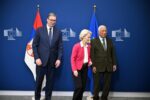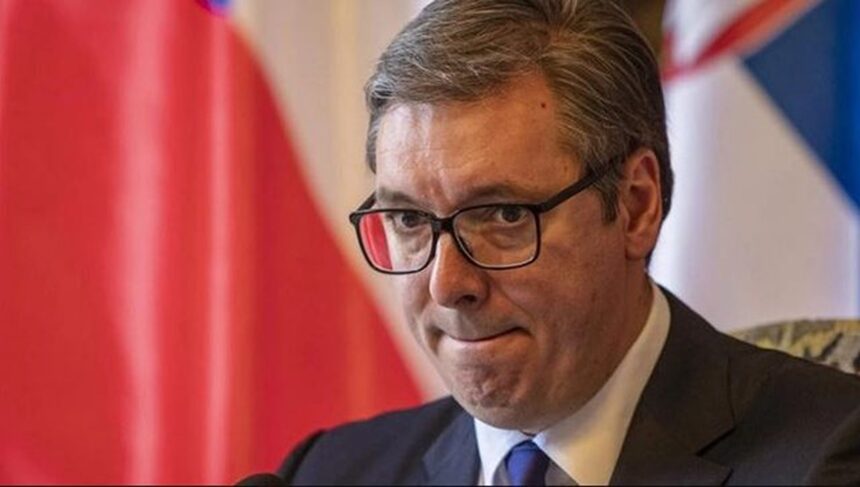
During a seemingly routine photo opportunity in Brussels, Serbian President Aleksandar Vučić once again raised eyebrows across European diplomatic circles. Caught on open microphones, Vučić appeared to murmur that he had “just received a message from Moscow” — a remark that immediately underscored concerns about his continued political proximity to the Kremlin at a time when Serbia claims to be pursuing EU membership.
An Awkward Moment With EU Leaders
As Vučić walked alongside European Commission President Ursula von der Leyen inside the Berlaymont building, cameras captured him whispering:
“Now I got a message from Moscow.”
Von der Leyen quickly cut him off, seemingly whispering back:
“Let’s… let’s wait until…”
— abruptly ending a conversation that should never have been audible.
The exchange happened just before the ceremonial group photo with European Council President António Costa, adding a layer of discomfort to what was already expected to be a tense visit.
A President Who Still Keeps a Line to the Kremlin
It remains unclear what Moscow allegedly communicated to Vučić. But one fact is uncontested:
Vučić is one of the very few European leaders who still maintains an active channel with the Kremlin, long after the EU severed most official ties following the full-scale invasion of Ukraine in 2022.
This reality stands in stark contradiction to Serbia’s official EU aspirations — and has repeatedly fueled doubts in Brussels about whether Belgrade is acting as a credible partner or as a Trojan horse for Russian geopolitical interests.
A Visit Dominated by Distrust
Vučić was in Brussels for a bilateral Serbia–EU meeting regarding the country’s accession process. However, this latest incident only reinforced a perception increasingly common among EU officials:
the Serbian government under Vučić is attempting to play both sides — pocketing EU funds while politically aligning itself with Moscow.
The moment comes at a time when negotiations to end Russia’s war in Ukraine are intensifying. Ukrainian President Volodymyr Zelenskyy confirmed this week that a refined peace proposal is being prepared for the United States, with input from European partners.
Meanwhile, U.S. President Donald Trump hinted he might travel to Europe for discussions only if such involvement would meaningfully advance negotiations.
A Critical Week for Europe’s Security
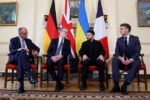
Separately, leaders of the “Coalition of the Willing” — more than 30 countries led by France and the UK — are gathering for urgent consultations on Ukraine. According to the French presidency, Europe is entering a critical moment for both Ukrainian sovereignty and continental security.
Against this backdrop, Vučić’s casual mention of a “message from Moscow” did little to inspire confidence in Serbia’s strategic alignment.
A Regime Increasingly Seen as Undermining Rule of Law and Western Values
While Vučić continues to publicly claim loyalty to the EU path, his regime’s long-term assault on independent institutions, the judiciary, and media freedom has drastically eroded trust in Brussels.
This latest open-mic remark only reinforces the growing consensus in EU institutions:
Serbia under Vučić does not behave like a genuine candidate country, but rather like a state-capture project balancing between democratic rhetoric and authoritarian practice.
And in Brussels — unlike in Belgrade — microphones occasionally reveal more truth than intended.