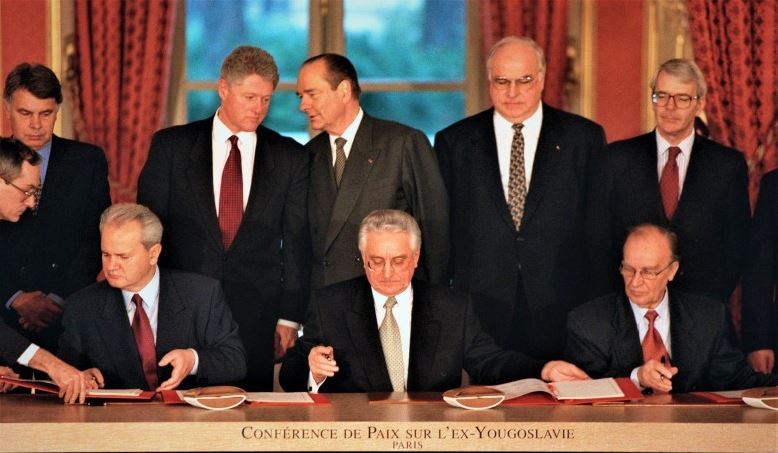
Thirty years after the Dayton Peace Agreement ended the bloodiest conflict in Europe since 1945, Bosnia and Herzegovina continues to live with the contradictions and structural weaknesses embedded in the accord. While the agreement succeeded in stopping the war, it simultaneously created a deeply fragmented political system that still fuels tensions today.
1. How Was the Dayton Agreement Reached?
The Dayton Peace Agreement was negotiated on 21 November 1995 at Wright-Patterson Air Force Base in Dayton, Ohio, and formally signed on 14 December 1995 in Paris. It ended a three-and-a-half-year war marked by ethnic cleansing, the siege of Sarajevo, and the Srebrenica genocide.
More than 100,000 people were killed, and millions were displaced. Only after NATO’s intervention in August 1995 did the warring sides agree to a ceasefire, enabling U.S.-led peace talks under the mediation of American diplomat Richard Holbrooke.
2. Who Negotiated the Agreement?
The negotiation table brought together:
- Slobodan Milošević (Serbia)
- Franjo Tuđman (Croatia)
- Alija Izetbegović (Bosnia and Herzegovina)
Each leader pursued their own national interests:
Milošević sought to protect Serbian territorial gains, including areas ethnically cleansed during the war; Tuđman aimed for territorial advantage for Croatia; and Izetbegović fought to preserve Bosnia’s sovereignty.
Notably, the political and military leaders of the Bosnian Serbs — Radovan Karadžić and Ratko Mladić — were not invited. Both were already under investigation for war crimes, with arrest warrants following shortly thereafter.
3. What Does the Agreement Establish?
The Dayton framework stipulates that Bosnia and Herzegovina remains a sovereign, undivided state within recognized borders, with Sarajevo as its capital.
The country is composed of two entities:
- The Bosniak-Croat Federation (51% of territory)
- The Republika Srpska (49%)
A three-member Presidency, a two-house parliament, a Council of Ministers, a Constitutional Court, and a Central Bank form the state-level structure. The central state holds authority over foreign policy, trade, customs, monetary policy, immigration, airspace, and since 2005, defense. Most other powers remain with the entities.
4. Foundation of the Agreement
The basis for Dayton was the Contact Group Plan, prepared by the U.S., Russia, the UK, France, and Germany. The plan effectively ratified wartime ethnic cleansing, granting 49% of the country to Serb forces despite the 1991 census showing they represented only 31% of the population.
5. Why Did the War Start?
War erupted in 1992 after Bosnia voted for independence from Yugoslavia. Bosnian Serbs, backed politically and militarily by Milošević, boycotted the referendum, proclaimed Republika Srpska, and launched a campaign of terror and expulsion against Bosniaks and Croats.
Nationalist leaders — Milošević in Serbia and Karadžić in Republika Srpska — deployed propaganda, fear, and violence to justify ethnic division, leading to massacres, mass displacement, and one of the longest sieges in modern history: Sarajevo.
6. Germany’s Role in the Dayton Process
Germany was part of the Contact Group and supported diplomatic pressure to end the war. Chancellor Helmut Kohl insisted on a political settlement crucial for Europe’s long-term stability.
In 1994, initiatives by Germany and the U.S. brought Tuđman and Izetbegović to an agreement that ended the Bosniak–Croat conflict and dissolved the self-proclaimed Croat Herceg-Bosna.
Germany also played a central role in the post-war period. Several senior German diplomats and politicians later served as High Representatives, the international authority overseeing civilian implementation of the agreement. Today, the position is held by Christian Schmidt.
7. Criticism of the Dayton Agreement
Despite its role in ending the war, the Dayton Agreement created a political system full of built-in tensions:
- Parallel, overlapping political structures slow down or block decision-making.
- Ethnic veto mechanisms make reforms extraordinarily difficult.
- Only the three “constituent peoples” — Bosniaks, Croats, and Serbs — have full political rights.
- Minorities like Roma and Jews are excluded from key political positions, a violation repeatedly condemned by the European Court of Human Rights.
- The agreement entrenched ethnic divisions, enabling continuous nationalist mobilization and separatist rhetoric, especially from political leaders in Republika Srpska.
Three decades on, Bosnia and Herzegovina remains a fragile state, one that is functional enough to avoid renewed conflict but too fractured to achieve full democratic consolidation or meaningful integration into the European Union.