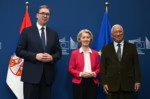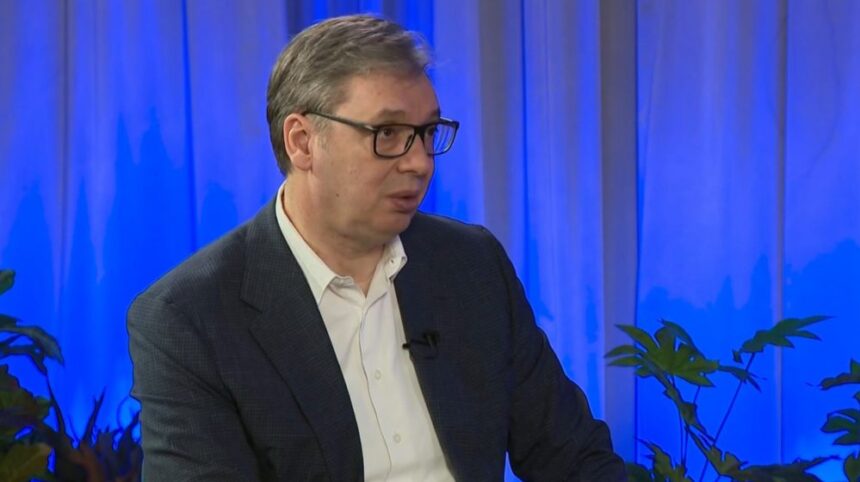
Serbian President Aleksandar Vučić stated on Thursday evening that the latest public opinion surveys show a deepening polarization among Serbian voters, claiming that the political bloc he leads is “growing faster” than the opposition. Appearing on TV Prva, he again denied confirming a future candidacy for prime minister, saying only that such a possibility “cannot be ruled out.”
Vučić highlighted results from the repeat vote in Jarkovac (Sečanj municipality), where the Serbian Progressive Party (SNS) list received more than 70% of the votes, calling it an “important signal.” He added that due to additional irregularities, another rerun will be held in the same village “within seven to eight days.”
Indictment as a Political Asset
Commenting on a possible indictment in the “General Staff case,” Vučić said that being charged would be the “crown of his career,” urging prosecutors to “file it immediately,” and insisting he is the “central target” of the entire process.
“It is the only thing left for me — to formally prove how I was persecuted. I worked under impossible conditions, and everyone used me as an alibi for their own failures,” he said.
Such remarks reflect what critics describe as Vučić’s longstanding strategy of portraying himself simultaneously as an omnipotent leader and a permanent victim — a narrative used to consolidate power and deflect accountability.
Defending Layoffs Through “Rising Wages”
Asked about the wave of layoffs in southern Serbia — affecting companies like Benetton, Geox, and partly Leoni — Vučić justified the trend by citing “significant wage increases,” which he claims have pushed out labor-intensive industries.
Analysts, however, argue that these closures expose the structural fragility of Serbia’s economy after years of state-controlled foreign investment policies, heavy subsidies, and a lack of genuine industrial strategy.
Foreign Investment: “Nothing Happens Without Subsidies”
On whether large companies such as Italian manufacturer Ariston could invest without state subsidies, Vučić said he held a series of meetings with the company in Davos and in Serbia, insisting that subsidies are unavoidable.
“You must offer subsidies, attention, legal certainty, and political stability. A factory is not important only for the 300 families who depend on it, but for everything else. Without factories — no life,” Vučić said.
Critics note that his version of “political stability” often translates into tight executive control, pressure on institutions, and limited media freedom, conditions that undermine long-term investor confidence.
Ambitious Construction Announcements
Vučić also announced forthcoming works on the delayed Niš–Dimitrovgrad railway, blaming the hold-ups on Serbian bureaucracy and last year’s collapse of the Novi Sad station canopy. Additional promised projects include:
- a new 15,000-seat stadium in Čair,
- a maternity hospital costing over €66 million,
- the second phase of the Clinical Center,
- and the reconstruction of two museums.
Such announcements follow a familiar pattern: large-scale infrastructure promises used to bolster public perception, even as watchdogs warn of opaque procurement practices and weak institutional oversight under Vučić’s rule.
Energy Uncertainty and the NIS Dilemma
Vučić warned that Serbia’s oil industry reserves will soon expire, and that government intervention could trigger secondary sanctions. He repeated that Serbia will wait until 15 January for a resolution, after which “Serbia will take matters into its own hands.”
“If Serbia is forced to take over NIS, the price will be very high — but we have secured the money,” he claimed.
Energy experts note that Serbia’s vulnerability stems from years of politicized management, limited diversification, and the government’s reluctance to distance itself from Russian influence — decisions closely tied to Vučić’s political calculus.
A Packed Schedule in Niš
The presidential media service announced that Vučić will continue his visit to Niš on Friday, visiting:
- the “Mija Stanimirović” barracks,
- Integrated Micro-Electronics,
- Yumis food production,
- the legalization center under the “Svoj na svome” program,
- Gadžin Han for meetings with citizens,
- TZR Recycling Industry,
- and Yusei Machinery.