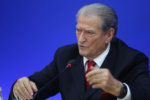
Former U.S. Assistant Secretary of State Daniel Fried has stated that the current U.S. National Security Strategy does not criticize Washington’s past support for Kosovo, stressing that American policy was never about creating a nationalist state modeled on the Milošević-era Serbia, but about building a democratic, inclusive country anchored in Europe.
Speaking to Radio Free Europe’s Expose program, Fried offered a critical assessment of the Trump administration’s National Security Strategy, arguing that it separates values from interests, clashes with other U.S. policies, and indirectly favors radical right-wing forces in Europe — in contradiction with long-term American strategic goals.
Why Kosovo Is Absent From the U.S. Strategy
According to Fried, the absence of Kosovo and the Western Balkans from the strategy reflects both a reduced sense of urgency in Washington and the expectation that Europe should now take the lead in the region.
He added that, given the ideological tone of the new strategy, it may actually be “better” for Kosovo not to be mentioned at all, as the document could easily have questioned earlier U.S. engagement in Kosovo’s state-building or human rights efforts.
“The strategy could have dismissed the Balkans as purely a European issue — or even criticized our previous focus on Kosovo, state-building, and human rights, which led to military intervention,” Fried said.
Contradictions Inside Washington
Fried highlighted clear contradictions within U.S. policymaking, particularly between the National Security Strategy and the National Defense Authorization Act (NDAA) currently advancing through Congress.
While the strategy signals potential disengagement, the NDAA:
- Guarantees the presence of 76,000 U.S. troops in Europe
- Restricts large-scale withdrawals of military equipment
- Strengthens support for the Baltic states to deter Russia
- Emphasizes concern over cooperation between Russia, China, and North Korea
On the Western Balkans, the NDAA states that sustainable economic growth and stability in the region are a shared interest of the U.S. and Balkan states.
It also welcomes the Agreement on the Path to Normalization between Kosovo and Serbia as a positive step forward, calling for immediate progress in its implementation and reaffirming that:
“The United States should continue to support a comprehensive, final agreement between Kosovo and Serbia based on mutual recognition.”
Fried described the language of the NDAA as “completely opposite” to that of the National Security Strategy, noting that it is supported by Republican leadership, including Speaker of the House Mike Johnson.
Risks of Reduced U.S. Engagement
Despite seeing “relative hope” in these contradictions, Fried warned that the Western Balkans would become significantly more vulnerable if the U.S. reduces its presence and engagement.
He cautioned that:
- China would seek to acquire critical infrastructure and economic leverage
- Russia would exploit fragile states as proxies to generate instability and chaos
- Both powers would treat the Balkans as a testing ground for broader geopolitical ambitions
“In every case, both Russia and China would see the Balkans as a field for advancing their wider strategic goals,” Fried said.
Europe Must Lead — Especially in Containing Belgrade
Fried stressed that the European Union must assume full leadership in stabilizing the Western Balkans, as the region’s only sustainable future lies within the EU.
He emphasized the need for Europe to restrain aggressive elements in Belgrade, warning that such actors continue to:
- Encourage renewed tensions in Kosovo
- Undermine Bosnia and Herzegovina’s stability
“When Europe fully takes responsibility, the space for Russia and other destabilizing actors to play games in the Balkans will shrink significantly,” Fried said.
Kosovo’s Core Mission: Democracy, Not Nationalism
Reflecting on his role in supporting Kosovo’s independence, Fried underscored that U.S. backing was conditional on Kosovo becoming a democratic, inclusive state — not a nationalist project.
“We supported Kosovo’s independence, and it was the right decision. But the agreement was clear: Kosovo must be democratic, not nationalist. We did not want a small version of Milošević’s Serbia,” Fried concluded.
He praised Kosovo’s flag as a symbol of inclusivity and European orientation, noting that it represents all citizens rather than a single ethnic group, reinforcing the country’s place in the European future.