Ukrainian President Volodymyr Zelensky is no longer insisting on Ukraine’s accession to NATO and is instead calling for a ceasefire along the current front line. However, the Kremlin remains unmoved and says it does not expect “anything positive” from the talks in Berlin.
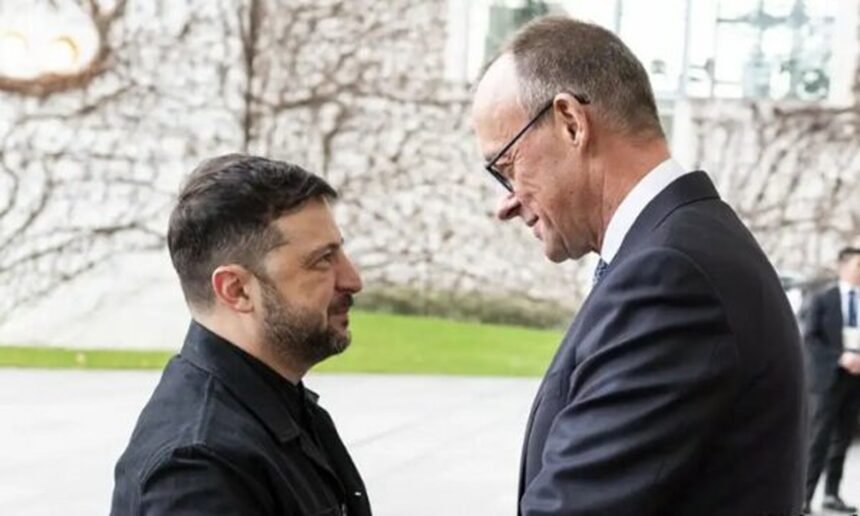
New negotiations on a peace plan for Ukraine are currently underway in Berlin. Ukrainian President Zelensky, U.S. envoys Steve Witkoff and Jared Kushner, along with other representatives from both sides, met on Sunday afternoon (December 14) at the German Chancellery. German Chancellor Friedrich Merz welcomed the participants but later withdrew from the negotiations held in the small cabinet room of the Chancellery, according to consistent reports. The talks in Berlin are being moderated by Merz’s national security adviser, Günter Sautter.
After more than five hours of negotiations on Sunday, both sides concluded the talks but “agreed to continue tomorrow,” Zelensky’s adviser Dmytro Lytvyn said. On Monday (December 15), Merz is expected to meet again with Zelensky and other European heads of state and government.
Shortly before the talks began, it became clear that positions remain far apart. While the Ukrainian side has shown willingness to compromise on certain issues and has called on Russia to do the same, Moscow has shown no signs of retreat.
Ahead of the meeting, Zelensky stated that Ukraine no longer insists on NATO membership. He told journalists that Ukraine’s aspiration lacks the support of all NATO member states. However, he added that it could be an acceptable compromise if the EU and the United States were to provide Ukraine with security guarantees similar to those offered by NATO.
Ukraine’s goal of joining NATO is currently enshrined in its constitution. Nevertheless, one of Russia’s key demands remains that Ukraine must never be admitted to the alliance.
“Preventing Another Russian Invasion”
Zelensky said that NATO membership has always been Ukraine’s preferred option because it would provide a “real security guarantee.” However, bilateral security guarantees could also serve as a means to “prevent another Russian invasion.”
This marks a significant shift for Ukraine, which for years has sought NATO membership as protection against Russian aggression and has even embedded this objective in its constitution. Russia, for its part, has consistently demanded that NATO membership for Ukraine be ruled out.
Withdrawal from Donetsk Rejected
Another Russian demand remains unacceptable to Zelensky: the withdrawal of Ukrainian troops from Ukrainian-controlled areas in the Donetsk and Luhansk regions. Zelensky said a ceasefire along the current front line would be fair, while Russia’s demand is unjust.
Ceasefire as a Basis for Diplomacy
“The fairest possible option is to stay where we are,” Zelensky said, adding: “That would be a ceasefire — both sides remain in their positions and then attempt to resolve all outstanding issues through diplomacy.” He acknowledged that Russia does not welcome this proposal and expressed hope for U.S. support.
The U.S. administration under President Donald Trump has once again increased pressure on Ukraine to accept a peace agreement. Trump believes that Ukraine, which depends heavily on Western support, is at a military disadvantage compared to Russia.
Russia Firm on Territorial Demands
Russian representatives dampened expectations ahead of the Berlin talks and reiterated Moscow’s long-standing positions. “It is unlikely that anything good will come out of the consultations in Berlin,” Putin’s foreign policy adviser Yuri Ushakov told Russian state television. He said that contributions from Europe and Ukraine to President Trump’s peace plan would “most likely not be constructive,” while praising the U.S. side for understanding Russia’s position.
Ushakov made it clear that President Vladimir Putin does not intend to abandon Russia’s territorial demands, stating that Moscow rejects any changes to its positions regarding territorial issues. /DW