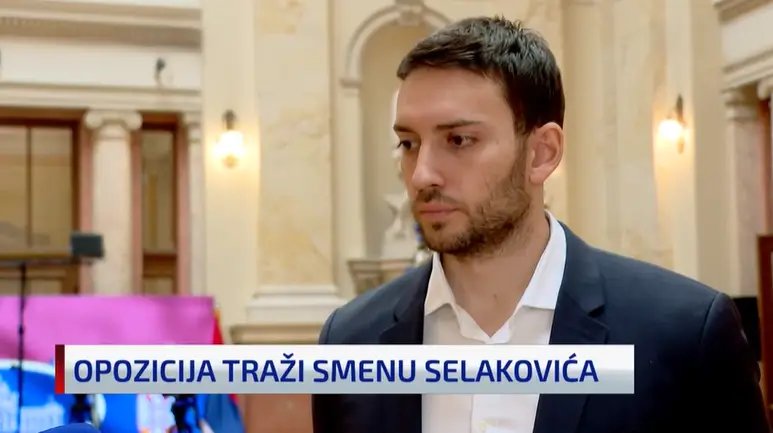
Pavle Grbović, MP and leader within the Free Citizens’ Movement (PSG), has strongly criticized the Vučić-led government, stating that Serbia has been internationally stigmatized as a country involved in corruption due to the controversial General Staff (Generalštab) project.
Speaking in the Serbian Parliament, Grbović said it is unrealistic to expect that Minister Nikola Selaković will either be dismissed or resign voluntarily, despite his alleged involvement in a corruption scandal.
“In any normal and well-regulated country, the most basic moral act is resignation when a public official is linked to corruption,” Grbović said.
Attack on Institutions Instead of Accountability
Grbović emphasized that under the Serbian Progressive Party (SNS), the system functions in reverse.
Instead of holding officials accountable, he said, the regime attempts to weaken and dismantle institutions that uncover corruption—particularly the Prosecutor’s Office for Organized Crime.
“Rather than removing ministers suspected of corruption, the SNS tries to destroy the prosecution that investigates and prosecutes corruption,” he stressed.
Despite this, Grbović welcomed recent actions by prosecutors, saying they show that the judiciary is still alive and collecting evidence, which could serve as a foundation for justice once the current regime leaves power.
International Reputational Damage to Serbia
According to Grbović, the General Staff project represents a serious national embarrassment, implicating:
- President Aleksandar Vučić,
- Minister Nikola Selaković, and
- Serbia as a whole.
“Because of this project, Serbia has been marked as a country involved in international corruption,” Grbović said, adding that Serbian authorities attempted to corrupt U.S. institutions in an exceptionally crude manner.
He accused the government of attempting to trade Serbia’s cultural heritage for private financial interests and short-term political gains.
Although the project ultimately failed, Grbović warned that the reputational damage to Serbia is severe and long-lasting.
False Narratives and Blaming Protesters
Grbović rejected claims by government officials that student protests and civic blockades are responsible for Serbia losing potential investments worth €750 million to €1 billion, allegedly redirected to Albania.
“Those investments are going to Albania because it is a NATO member, a U.S. ally, and on a clear path to EU membership,” he said.
He added that Albania’s leadership has not been involved in international corruption scandals, nor has it attempted covert lobbying or illegal influence-peddling abroad.
Who Are the Real ‘Blockers’?
Grbović concluded by directly challenging the Vučić regime’s narrative:
“The real blockers are not students demanding justice in the streets. The real blockers are those who prevent justice from reaching Serbia, those who try to shut down the Organized Crime Prosecutor’s Office, and those who fear elections and the will of the citizens.”